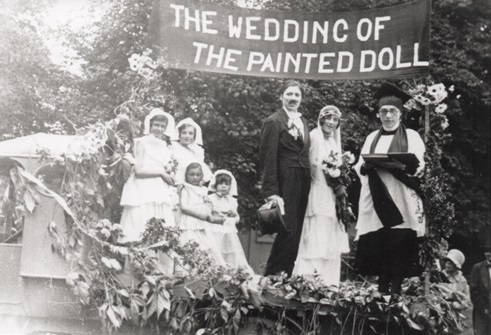
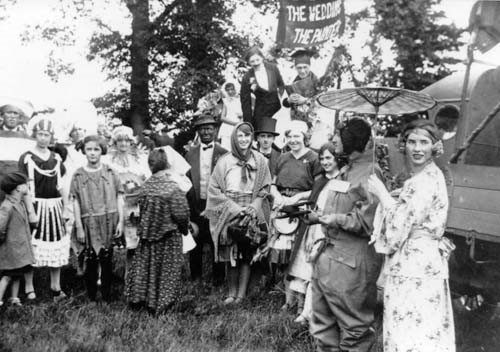
During our preparations for the current exhibition of photographs in the Wychwoods Library in Milton (July-September 2026) , we revisited these two pictures of a tableau at the 1930 fete at Ascott under Wychwood, with its banner ‘The Wedding of the Painted Doll’. The float is draped in flowers and greenery, carries a bridal couple, a solemn ‘minister’, and a retinue of doll‑like attendants.
Ascott under Wychwood. Fete 1930. The Wedding of the Painted Doll
The full entourage around the float of The Wedding of Painted Doll
What Do We See?
In the 1930s and 1940s it was instantly recognisable. The scene on the float is a local re‑imagining of a musical number from early Hollywood. It was a hit song-and-dance sequence in The Broadway Melody (1929), written by Arthur Freed and Nacio Herb Brown.
Here is the performance as it would have been seen in cinemas throughout the UK.
About the Song
The song describes a toy‑box wedding procession, celebrated as a holiday. The chorus announces that “today’s the wedding of the painted doll”, with storybook characters such as Red Riding Hood, Buster Brown, and a jumping jack arriving as guests. Church bells ring while ‘little dollies from the follies’ gather with their painted cheeks.
The film routine narrates the ceremony, and features:
Bridesmaids in fancy laces who take their places.
The bride, a ‘little cutie’ and ‘little beauty’, appears.
A preacher man opens his ‘little black book’, confident because he has performed the ritual many times.
The bridegroom arrives, slightly nervous, and the preacher pronounces them married ‘to stay’.
The chorus repeats, celebrating the whimsicdding and the spreading of the news with ‘rice and shoes.’
The Song Spreads its Wings
Digging a little deeper for more information, we found that the film was first shown in Banbury in late November 1929, and when the fete at Ascott took place the film was the latest thing showing in the local cinema.
Meantime, ‘The Wedding of the Painted Doll’ quickly became a popular item in the repertoire of local dance bands, and not to be outdone, attendees at meetings of Deddington WI were entertained by a member who whistled the tunes from the film!
The choice of a theme such as ‘The Wedding of the Painted Doll‘ shows a 1930s village well aware of wider popular culture. It reminds us that communities in the Wychwoods were certainly not isolated from the wider world, and were absorbing new trends as part of older, established festival traditions.
This article was written by Carol Anderson to accompany an exhibition of wedding photographs from the Society’s collection spanning the later 19th to mid 20th century.
Some of the photographs in the exhibition are accompanied by names and dates, allowing us to trace the lives of the people who appear in them. Others have lost their identities over time , but can still offer valuable clues to changing traditions.
The article looks at changing marriage customs and fashions, gives some guidance on dating photographs and explains where to find records of past Wychwood weddings.
The article can be seen online here, and can also be downloaded as a PDF.
Marriages are the most celebrated of all family occasions and many families have photographs in their albums recording such events. A number of photographs of Wychwood weddings dating from the late 19th century to 1960, have found their way into the collections of the Wychwoods Local History Society. Sadly, some of these remain anonymous, a salutary reminder to us all to add names and other information to our photographs for the benefit of future family and historians! Others have been identified with the help of clues within the images themselves and the odd name or date.
Frozen in a single frame, a wedding photograph may reveal far more than the identities of the bride and groom; it can offer a glimpse into the social history of an entire community.
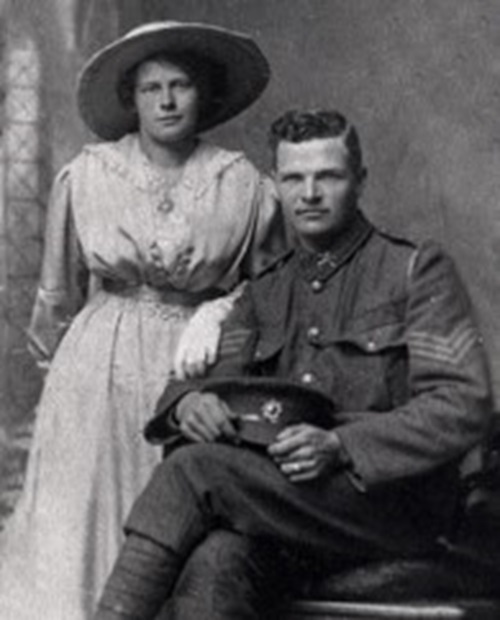
But until well into the 20th century, only better-off families could afford to employ a photographer to attend the wedding itself. Couples who wanted a record of their marriage often visited a local studio after the event, which makes the resulting images harder to distinguish from standard portraits. In some cases, wedding photographs took the form of individual studio portraits which would be displayed side by side in the family home, but on their own they can look much like any other portrait. One clue that these are wedding portraits is that the bride’s ring is often prominently displayed.
Studio Portrait of Sergeant James Beaney and his wife Margaret Hopkins. May 1916
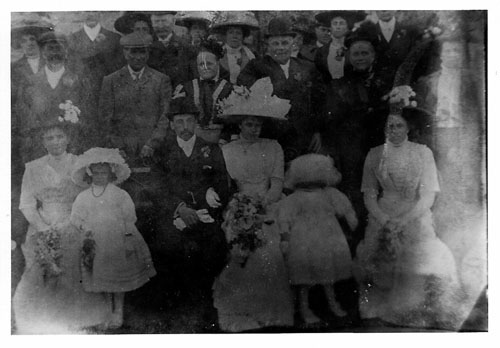
The style of the bride’s dress, the hats and outfits worn by guests, and the bouquets carried, all follow an identifiable chronology informed by the fashions of the day, which often helps to date anonymous wedding photographs. The 1890s saw the development of large group wedding photographs, often taken outdoors in the churchyard after the ceremony or in the garden of the venue for the reception, and featuring the growing middle class. The custom for brides and bridesmaids to wear floral corsages and sometimes to carry a bouquet was also growing at this time. Edwardian (1901-14) wedding photographs often look very grand owing to the extravagance of the accessories worn by the women, especially the enormous hats and the growing trend for extravagant bouquets with trailing greenery.
The Edwardian wedding of Sarah Belcher and Robert Cummins which may have taken place in Fifield
Queen Victoria had introduced the fashion for white wedding dresses but, as ordinary girls could not afford the luxury of a dress that could be worn only once, the fashion was slow to become established throughout society. By the early 20th century, although more brides were adopting white wedding attire, many women such as Margaret Hopkins, might simply choose a white blouse with a coloured skirt worn with a white hat.
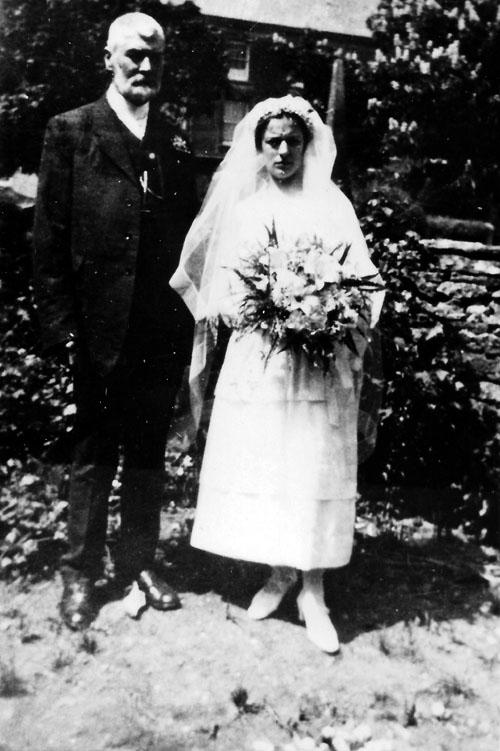
Following fashion trends wedding dresses and skirts were worn shorter from around 1915 onwards, displaying the lower leg and inspiring a fashion for white stockings and dainty shoes. Other clues as to date are also provided by trends such as the wearing of military uniform in time of war.
Ernest Dee and his wife Rebecca Coombes who married in Shipton in 1920
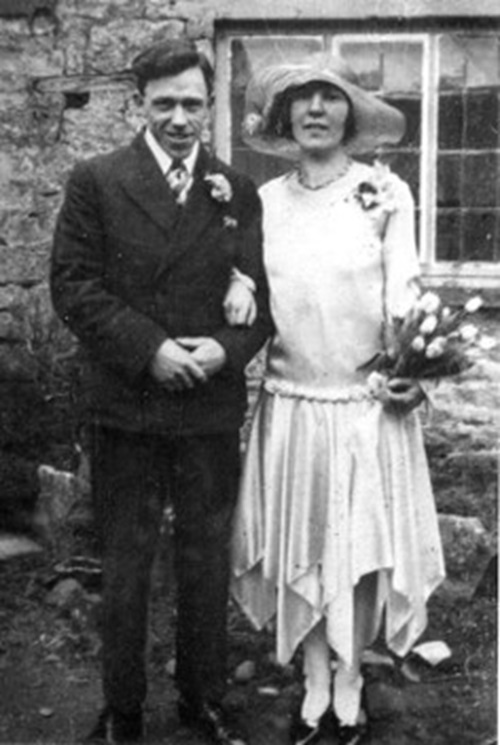
The early 1920s saw several important royal weddings at which the brides wore lavish gowns that inspired a new generation of brides, and revived the desire for a more romantic look which had been largely absent from wartime weddings. Most 1920s bridal and bridesmaid dresses were worn in a fashionable ‘afternoon’ length, but hemlines did move around between mid and lower calf, although in 1926 they rose dramatically to just below the knee. Head dresses (often low on the forehead), net veils and hats continued to be worn.
A bride thought to be from Milton in a very fashionable late 1920s dress
There was also a fashion in the later 1920s for young flower girls to wear distinctive wired headdresses like Dutch caps. Upper and middle-class bridegrooms continued to wear a dark morning coat and grey trousers, whilst other classes favoured a lounge suit with short, narrow legs and turn-ups. A knotted tie or bow tie was worn and stylish felt homburg and trilby hats replaced the traditional bowler.
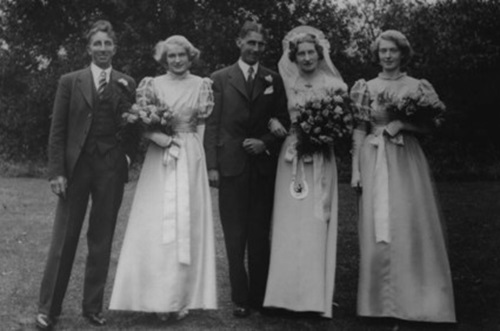
By the 1930s bridal styles had become very diverse. Influenced by Hollywood, soft, clinging, elaborate wedding gowns of varying lengths, including an evening length that swept the floor with a long train, became popular. Carnations and roses continued to be favoured for wedding bouquets, a trend that continued into the 1940s, but white lilies also came into fashion. By the late 1930s long, trained gowns in pure white satin held sway. Male attire followed the already established pattern but adopted 1930s fashion for double-breasted lounge suits.
Church weddings continued to take place throughout the Second World War. In response to circumstances many brides chose to wear smart knee-length dresses or suits with a floral spray or neat posy and a stylish hat. Cloth shortages dictated that the wedding gowns (although some brides adapted dresses from the 1930s) of wartime and post-war brides were generally made with narrow or only slightly flared skirts without trains, but veils were often long and worn well back on the head with a tiara. Bridesmaids often wore short veils, a useful clue to dating. As so many men were in the services it became common for men of all classes to wear their uniform. For those not in uniform a three-piece, double-breasted lounge suit was the norm.
Henry Bryan Edginton and his wife Daphne Rose 1940
Photography itself can also provide clues to the date of a wedding. As cameras gradually became more widely available, and more people could afford to employ a photographer to attend the event and even take photographs themselves, so often more photographs of the wedding and its participants have survived. The outdoor group photographs which began to appear in the late 19th century gradually became more common in the early 20th century and increasingly several different photographs were taken of the event. During and immediately after the First World War studio portraits became common again.
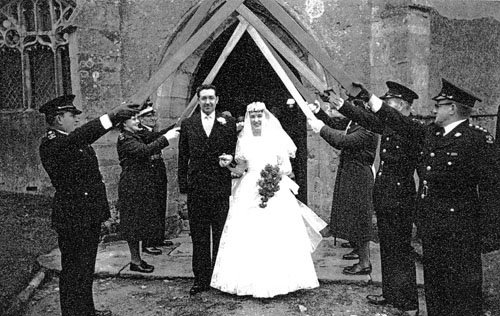
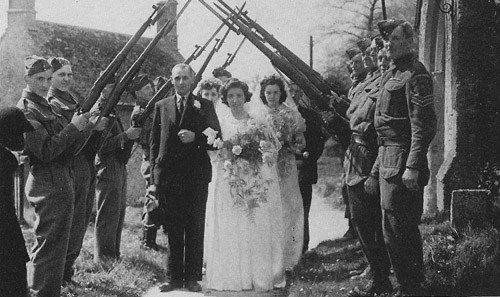
Fashions also developed within wedding photography alongside the technology, as the photographer looked to capture the informal as well as the formal aspects of the wedding. A greater range of standard images began to appear including the bride getting out of her car or standing at the church gate with her father, or the happy couple leaving church between the ranks of their guard of honour.
Mr & Mrs Puddle ‘guarded’by the St. John Ambulance Brigade
Until the mid-18th century marriages could take place anywhere, provided they were conducted before an ordained clergyman of the Church of England. This encouraged secret and bigamous marriages which did not have parental consent. The Marriage Act of 1753 declared that all marriage ceremonies must be conducted by a minister in a parish church or chapel of the Church of England to be legally binding. No marriage of a person under 21 was valid without the consent of parents or guardians. Clergymen who disobeyed the law were liable to 14 years transportation. Jews and Quakers were exempt from this law, but religious non-conformists and Catholics had to be married in Anglican churches.
Marriages usually took place in the parish where the bride was living, but if she were not living at home or her parents were dead, the marriage could take place where she or the groom were living.
Early Wychwoods marriages took place in parish churches in Ascott, Fifield and Shipton, although it was not until 1538 that all parish priests were required to keep registers of baptisms, marriages and burials. Some Catholic parishes kept spasmodic records as early as the 13th century. The earliest surviving recorded marriage in Shipton took place in 1528 and in Ascott in 1570. Milton did not have a parish church until 1855, before that time anyone living in Milton would have married in Shipton. Likewise, as it did not have its own church until 1853, Leafield marriages often took place in Shipton or Ascott.
In 1836 new legislation enabled Non-Conformists and Catholics to be married in their own places of worship. The Milton Baptist Church features as the background to Groves family wedding photographs in the later 19th century, but the Baptist chapel in Ascott did not hold its first wedding until 1957.
From 7th July 1837, alongside religious ceremonies, all marriages had to be documented centrally via District Registration Offices. It also became possible to be married in a Registry Office without the need for a religious service.
The age at which couples could marry also changed over time. In 1929 the legal age for marriage with parental consent was set at 16 (it had previously been 12 for girls and 14 for boys). In 2022 this was increased to 18.
Where Can I Find the Record for a Wychwood Marriage?
The digitised records for church marriages up to 1930 are available online from the genealogical subscription site Ancestry. These can be consulted free of charge in the Wychwood Library, as can marriage records, including Roman Catholic Parish Records, held by Findmypast.
Using the search facility of the FreeBMD online site [ here – opens in new tab ] you can find references to marriages recorded in the Chipping Norton district (which covers the Wychwood villages) from 1837 to 2000 (the records aren’t yet complete from about 1994 onwards). From these records, with a little detective work, it’s possible to establish the names of those marrying and the quarter (of the year) in which the marriage took place. To obtain more details you need to order a copy of the certificate from the General Register Office [ here – opens in new tab ] which maintains the national archive of births, marriages and deaths dating back to 1837.
Hard copy transcripts of parish registers, including both marriages and banns (for those from the parish who were being married elsewhere), from Ascott, Fifield, Leafield, Milton and Shipton with surname indexes, are held by the Wychwoods Local History Society. Please contact us to discover more.
Although the most recent Wychwood wedding photograph in the Society’s Archive dates from 1960, articles written by Wendy Pearse in the Ascott Grapevine: these bring us almost up to date with a selection of images of weddings that have taken place at Holy Trinity Church in Ascott up to 2021.
These days the Society is receiving an increasing number of overseas visitors to our website. Among these we recently heard from an Australian artist, who described herself as ‘a painter who uses old photographs’.
She had seen an article on our website which referenced Cecil White, an ancestor of hers. In 1916 Cecil came to England for military training, as part of the Australian Expeditionary Force. He took the opportunity to visit the village where his father had been born and meet his White cousins still living in Ascott.
During his visit, Cecil had taken several photos of the village. Could we help her to source some of these photos?
We were delighted to help. And meantime it took us on our own journey of discovery, with Carol Anderson following the story.
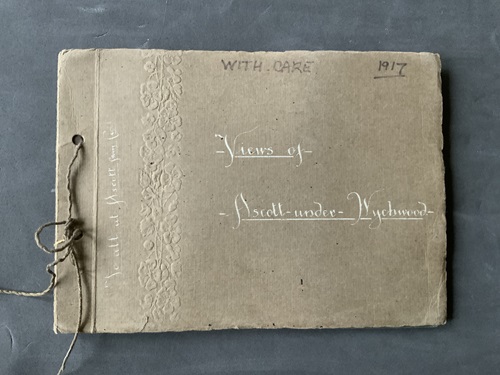
Cecil White’s Photograph Album
Cecil White’s Photograph Album. With thanks to Harvey Warner
On his return home from his 1916 visit, Cecil compiled an album of 14 of the photographs he took on his visit. He also included 4 images of other places in England – Tilbury Docks, Greenhill House/ Sutton Veny House and parish church, Wiltshire.
Two further photographs feature a group of Australian NCOs on board ship and a portrait of Cecil in uniform.
As a result of this enquiry Carol has been able to organise a full record of the album and its contents, the scans of which are now safely archived.
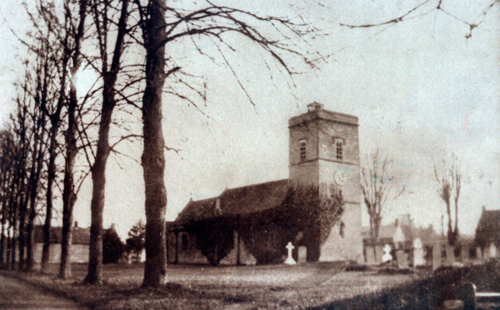
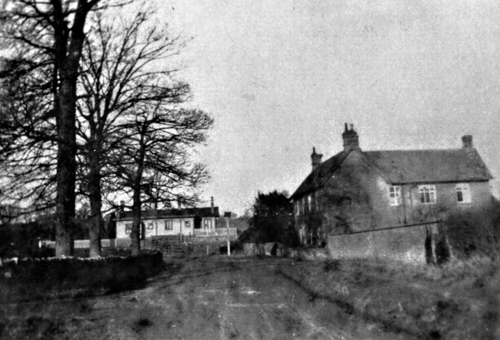
Here are some examples from our online photo archive.
Unusual view of North side of the parish church photographed from across the churchyard from northwest
View north from the Green along London Lane towards the railway station. Churchill Arms, later Sunset House, on the right
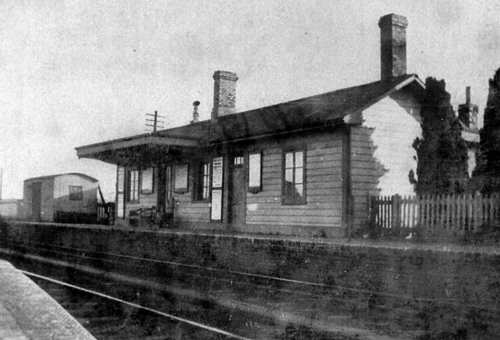
Railway platform and wooden station building on south side of railway line view looking east
Cecil White – A Family History
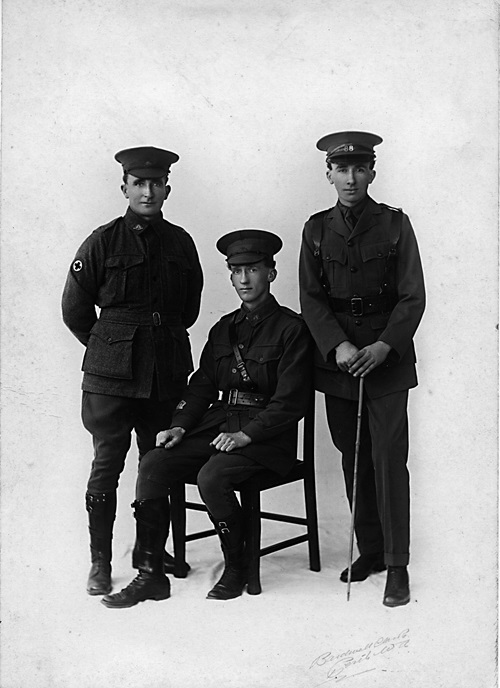
Cecil White sitting between his brothers George (left) and Baden (right) . Photograph was taken in the Bardwell Clarke studio in Perth Western Australia.
During the 1850s a William James White came to Ascott-under-Wychwood to take over the forge overlooking the village green. William was one of twelve children, six of whom died in childhood, born to blacksmith William White and his wife Elizabeth, who lived in Christmas Common near Watlington.
When William James came to Ascott he was married to a Mary Ann Eustace. In the 1861 census William James was 31, and Mary Ann was 27 and they are recorded as having four children, William James Jnr., Harriet, George, and Susan.
Blacksmith William’s brother, Alfred, joined the Metropolitan Police and rose to the rank of Sergeant. He married Mary Elizabeth Harvey, who came from St. Pancras, and they had a daughter, Hannah. Alfred resigned from the Police and died soon after in May 1865.
William White’s wife Mary died in 1865 aged 33, having given birth to another son Frederick. Some time afterwards his brother Alfred’s widow, Mary Elizabeth, and her daughter Hannah came to live in Ascott, perhaps to look after William and his children.
On 10 August 1867 William James and Mary Elizabeth were married in the Wesleyan Methodist Chapel, Chipping Norton. At this time, it was illegal for a man to marry his brother’s widow, and this may explain why they were married away from Ascott, in a non-conformist ceremony in Chipping Norton.
After they were married, and before he died in Ascott in April 1874, William James and Mary Elizabeth White had three children, Francis William, Mary Agnes, and Charles Harvey, who were therefore half-siblings to the three boys from William’s first marriage who were later to emigrate to Australia.
When his father died William James jnr., the eldest son of blacksmith William by his second marriage, was about 18 and became the first of his family to emigrate to Perth, Western Australia. In the 1871 Census he is recorded as aged 15 living with the rest of the family in Ascott and his occupation is that of a shepherd (he had not followed his father and grandfather into blacksmithing), a role that may have fitted him for work in Australia.
Subsequently, and separately with other young men from the village, two more of the White family also emigrated to Western Australia where a group of Ascott ex-pats seem to have gathered around Perth. Frederick White (aged 16/17) had emigrated by 1880. Currently, nothing further is known about Frederick. George White, the third of William and Mary’s sons to emigrate, arrived in Perth on the Charlotte Padbury in September 1881 and married Jane McGowan in 1884 but died the following year aged 26.
William James Jnr., the first of the family to emigrate, married Annie Coffin at Yatheroo in 1879. They had four sons and two daughters. Three of their sons joined the Australian Expeditionary Force (AEF) in World War I. The eldest, George, joined the Australian Army Medical Corps and served in Egypt. Bason, the youngest, was still too young to serve abroad when the War ended.
William and Annie’s second son, Cecil, married Ivy Derepas in Perth in 1915 and later, as a Sergeant in the AEF, was sent to England. On leave there, whilst completing his training, he travelled to Ascott to see his father’s birthplace. Here he met the family of his father’s half-brother, Charles Harvey White who had married Kate Honeybone and had three surviving children, Charles, Florence and Doris.
In January 1919 he sent his cousins, the White family of The Old Post Office (aka Centuries House), London Lane, an album containing copies of the photographs he had taken on his visit.
The album is now in the possession of Harvey Warner (Charlbury) son of Doris Warner (nee White, daughter of Charles White).
Research by Carol Anderson
Sources:
1861 & 1871 Census: Ascott-under-Wychwood
Information provided by Harvey Warner
See Wendy Pearse’s article which initiated this story
Langston House in Milton-under-Wychwood was a small, community-valued care home that operated from the late 1970s until its closure in 2005. It served as a vital residential facility for elderly residents.
Here is a brief historical overview of Langston House:
Langston House: Origins and Operation
A party at Langston House – Care Weekly prize winner December 1987. Photo by Peter Arkell
Opened in 1977, Langston House was established as a residential care home in Milton under Wychwood.
It was one of the few care homes serving the rural villages in central Oxfordshire, offering accommodation and support for elderly residents.
In many ways, Langston House was a groundbreaking care home. It redefined elderly support in the region. Managed by what was possibly the county’s youngest supervisory team – Sandra Garrett, Heather Smith, and Marion Jesty -the home stood out not only for its leadership but also for its innovative design and community integration.
Sandra Garrett, Heather Smith, and Marion Jesty – from a 1977 newspaper cutting
The design of Langston House linked it directly with council-owned senior flats, creating a hybrid model of independent and supported living. Residents could choose to cook for themselves or dine communally, while benefiting from services like meals on wheels, laundry, and day care.
Designed by county architects Trevor Hendy and Brian Hook, the single-storey building housed 14-16 residents in two family-style groups. Its wheelchair-accessible layout, landscaped courtyard, and shared spaces fostered a homely atmosphere and encouraged independence.
The opening of Langston House marked a shift toward dignity, autonomy, and community involvement in elderly care
The home was highly regarded by the local community, known for its personal care and close-knit environment.
Molly and Edna Seach - residents at Langston House
Snapshot of Mrs Irene Collier. Date possibly 1990s
Snapshot of Mrs Gwen Harrison, resident
Mr Eddie Townsend at the home during Christmas. Eddie Townsend was a WW2 aircraft navigator.
Snapshot of Langston resident Ethel Bradshaw enjoying a meal on a trip to Bournemouth in 2004
Miss Seach at a window at the home in Milton . Date not known
Mr Bertie Fields, handyman at Langston House. Pictured late 1980s.
Langston House staff members 1990s - Helen Esson / Andrea Davis /Annie Hawtin/Mary Collins
Small group from a Langston House excursion in 1998 to Essex (exact location not known)
Shirley WIllis with her mother Mrs Adderley - interior of Langston House
Group from Langston House at breakfast during an outing to an Essex location (not specified) c.1998
Snapshot of Mrs Nan Greenaway at the home in Langston House, Milton.
Mrs Mary Wilson, resident, at Christmas. Date not known
Jeannie Brooker at home in Langston House, late 1990s
Resident Tom Barrett at breakfast - Langston House Milton under Wychwood
Snapshot of Annie Hawtin, staff member - Langston House Milton under Wychwood
Snapshot of Joyce Griffen (Griffin?) at work in the kitchens at Langston House Milton
Snapshot of Mrs Nan Greenaway at the home in Langston House, Milton.
Snapshot of Molly Seach at the Langston House care home
Ms Shayler and Ms Eden busy with craft work at home in Langston House
Lillian James at a window in Langston House
Snapshot of Mrs May Aken (?), at home in Langston House
Langston Leggies Football Team : Angie, Dot,Debbie,Pauline,Marian,Pat,Michelle: Front Row: Cherie, Iris, Anne,Denise,Mikki and Julie. Surnames anyone?
Annie Bishop District Nurse (1977-1980)
Easter Sunday 1980: Facing the camera left to right: Mrs Bradley, Mrs Rosie Parsons,Miss Maude Peacock,Miss Nellie Lydiatt,Mrs James,Mrs Stroud. Back to camera: Mr Harold Timms,Mr Arthur Slatter
Initial 1977 Staff Members from a Newspaper Scan (unidentified title/edition). Mrs Sandra Garrett, who moved to Oxfordshire from Wiltshire - head of the home; Mrs Heather Smith - aged 23, deputy and Mrs Marion Jesty -aged 22
Langston House staff choir at Christmas 1979
Langston House Christmas 1979
Group at table May 8th 1995. Molly Seach and Pat Williams in the group
Langston House resident Rose Burson on her 100th birthday
Decorations around Rose Burson's 100th Birthday Telegram from Queen Elizabeth II
Charlie (Resident) And Kath (Staff) - Surnames anyone?
Gwen Harrison (Wheelchair) and Helen Cross on holiday at Hoburn Naish Holiday Park near Mudeford 2003
Helen Cross, resident
Mrs Rainbow on Holiday at Hoburn Naish Holiday Park near Mudeford
Langston House - Outing to Bournemouth 2004. Bill Liddle, Gwen Harrison (Residents and Denise Palmer (Staff) July 2004. All 3 were to moved to Madeley Park when Langston House closed down
Staff bid farewell to the last residents leaving Langston House Care Home Milton under Wychwood March 2005
A group of staff members bid farewell to residents leaving the home at closure March 2005. One of two photos of the scene.
Closure and Community Response
In 2004, Oxfordshire County Council proposed closing Langston House as part of a broader review of care home services in the region. Langston House had 16 residents at the time.
Oxfordshire County Council cited financial sustainability and the need to modernise care services as reasons for the closure. The council’s review aimed to consolidate services and shift toward more cost-effective models, which often meant closing smaller, rural homes like Langston House
Community and Political Opposition
The proposal was met with strong resistance from the local community, who feared the loss of a vital institution.
The plan sparked significant local concern, with residents, families, and local officials voicing opposition. Then-Witney MP David Cameron raised the issue in Parliament, describing Langston House – alongside Castle View (Chipping Norton) and Spencer Court (Woodstock) – as a “wonderful home” that met all government standards and was “highly valued by the local community”.
Cameron emphasised the importance of keeping care homes close to where people live, even if they were small and not always profitable. He argued that the decision ultimately came down to funding priorities, stating, “the buck stops with the Government”.
Community Mobilisation
Public meetings were held at Milton Village Hall, especially on October 24th 2002, where village residents, families of care home residents, and local councillors including Hilary Biles, gathered to express their concerns.
The meetings focused on the emotional and practical impact of losing a local care facility, especially for elderly residents who would be displaced.
Attendees emphasised that Langston House was not just a care home but a community institution, deeply woven into village life.
Petitions and Advocacy
Local residents organised petitions and letter-writing campaigns to Oxfordshire County Council.
Many highlighted the home’s compliance with government standards, its high-quality care, and the lack of alternative facilities nearby.
Despite these efforts, the home closed in 2005, marking the end of over three decades of service.
Impact and Legacy
The closure highlighted tensions between economic efficiency and community-centred care, a theme echoed in broader debates about care home closures across England.
A Tribute to Langston House
In preparing this outline of Langston House history, we remind ourselves that Langston House was more than a care home — it was a sanctuary of warmth, dignity, and community. For over 30 years, it offered comfort and companionship to the elderly of Milton-under-Wychwood and surrounding villages. Its closure in 2005 marked the end of an era, but its legacy lives on in the memories of those who knew it.
Sources
Here are some key references behind this summary:
BBC News – Report on the concern at the care home closure plan (Feb 2004)
Executive paper that records the outcome of the April–July 2004 consultation: Executive report (EX210904-07) presented to the County Council Executive on 21 September 2004.
This report explicitly recommends closure of Langston House and sets out the rationale and the proposed re-provisioning.
‘Dr Sandy Scott was .. no less the colourful character than his father. ….. He was always a fiery defender of local amenities. Those who witnessed his address at a public meeting to try to save Langston House from closure were delighted to hear the sort of impassioned appeal they themselves would like to have made, had they been imbued with the ability to do so.‘
This essay by Diane Melvin explores the history of six cottages at Upper End, Shipton, from 1797 to the present day.
Diane traces the ownership, occupancy, and development of these cottages, while reflecting broader changes in the parish.
Research sources include deeds, census records, maps, and local memories.
This research came about after Diane, who is an enthusiastic genealogist and teacher—began investigating her own cottage during summer breaks. Discovering links among the original six houses, the project expanded into a wider study. It culminated in this ‘Little Houses’ report, created as part of a university assignment.
A fully documented version of this essay available in the WLHS archive which references all sources used. This extended version can be supplied in digital form to anyone interested. [ Contact us here >>> ]
The house now known as Forest Gate, on Frog Lane, Milton-under-Wychwood is one of the most distinctive properties in the Wychwoods, with the added mystery of an unusual terracotta figure decorating its roof line.
Here is new research – available here to download as a PDF – which uncovers the fascinating history of this house of distinctive architectural style, and the stories around the occupants of the house over time.
Across a hundred years, Leafield Radio Station evolved from scientific curiosity to imperial linchpin, from education powerhouse to pit-lane thrill machine. Its buildings may fall silent, but its story continues to transmit through those who remember and retell it.
Leafield Radio Station: 1988 redevelopment
Here we offer a brief summary of the history of the site from the early 20th century. Much of the material here is taken from the records in an archive folder on loan to WLHS by former employee Bryan Hunt. We also include an album of photographs taken from the folder, as well as a pair of interesting video clips from British Pathé.
Leafield Radio Station : Pioneering Beginnings (1912–1918)
In 1912, the visionary Marconi company selected Leafield’s high elevation for experimental radio transmissions under the Post Office’s guidance.
Before this, the site hosted humble meteorological huts — clues to its scientific potential.
With the outbreak of WWI, operations paused, but the site’s significance earned it military protection.
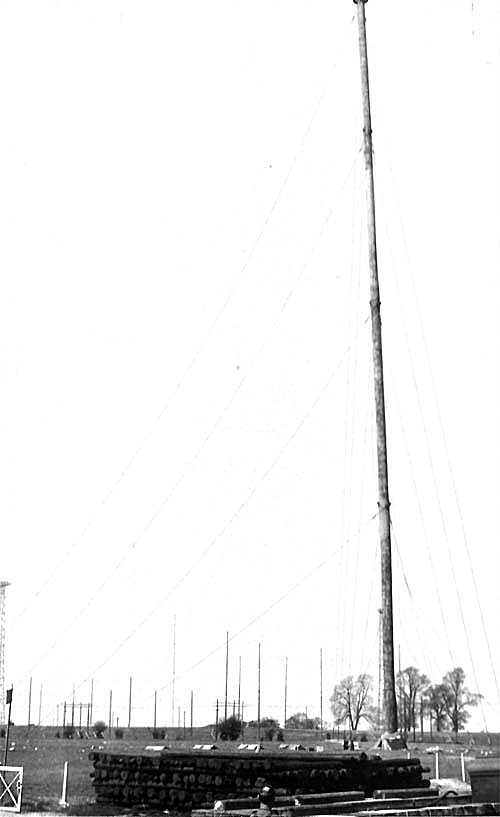
305-feet mast with crows nest, 1920s
The Imperial Wireless Chain (Post-WWI–1940s)
After the war, Leafield joined the ambitious Imperial Wireless Chain to link the British Empire via radio telegraphy.
Thirteen 305-ft masts were erected using a ladder-hoisting method that tested the mettle of early engineers.
By 1943, weather damage and steel shortages led to the masts being encased in concrete, boosting their weight to 120 tons.
Leafield became a hub for Reuter press, maritime, and government radio transmissions.
Leafield Radio Station. Masts encased in concrete.
Powering Progress
To support its high-voltage transmitters, Leafield built a coal-fired power station with twin 800HP steam turbines.
The ash produced formed the “ash track” road — still locally referenced today.
The site grew from 152 to 600 acres, with much of the land leased for aerial fields and sheep grazing.
Wartime Ingenuity & Camouflage
During WWII, buildings were camouflaged and a plywood decoy erected nearby to fool enemy aircraft.
Troops and local Home Guard units guarded the station continuously.
In 1982, Leafield served again during the Falklands War as a long-wave communications link.
Leafield Radio Station: A New Era (1961–1986)
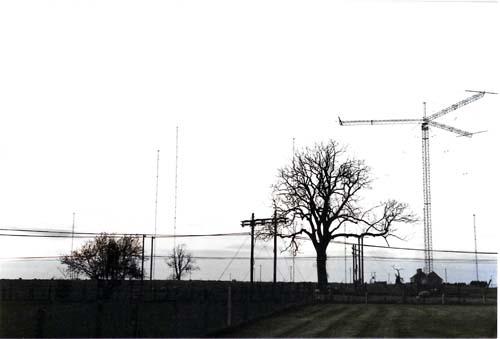
Leafield Radio Station: The massive original masts were replaced by smaller ones which covered fields surrounding the site. On the right is an example of the rotatable log periodic antenna system used.
A modern £1M radio station rose in 1961 with futuristic buildings, 80 steel masts, and automated technology.
Opened in 1962, it was hailed globally as one of the finest.
By 1986, satellite communication had rendered it obsolete, and the station closed. BT Group acquired 12½ acres in 1988.
Leafield Training College (1960s–1994)
Training began soon after the station’s modernisation, with hostels and lecture spaces created from repurposed buildings. Hostel with 50 bedrooms built; unused engineer bungalows used as annexes.
The college expanded with the Red Corridor wing, welfare block, and dining facilities.
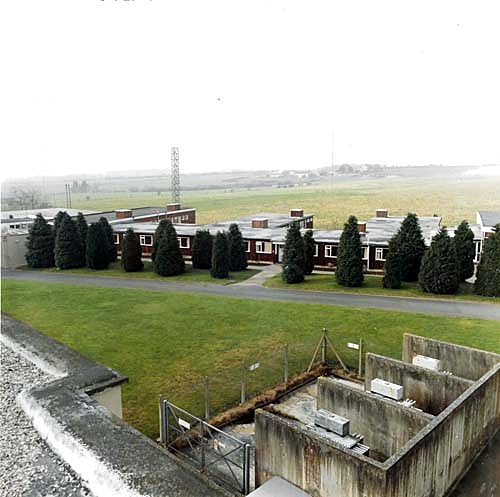
Leafield Radio Station: Hostel and Welfare Block 1989
By 1986, East Wing included 38 modern en-suite bedrooms. Training evolved into satellite systems, submarine cable platforms, rigging expertise and AXE test beds.
In 1988, BT Group approved a £5.5M transformation, completed in 1991 — but despite optimism, the site was closed in 1994 as BT restuctured its training systems.
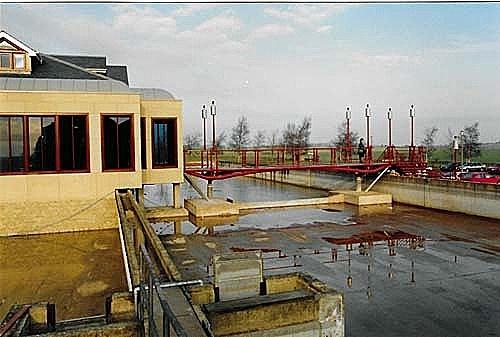
Leafield Radio Station: Bridge over cooling ponds from the car park to the reception area-1988
Motorsport Activity (2000s–2015)
After BT’s departure, Leafield found new life in motorsport.
Leased to Tom Walkinshaw Racing (TWR) as a Formula One development hub for Arrows F1 until 2002.
From 2006–2008, Super Aguri F1 operated from the site.
Menard Competition Technologies (MCT) joined next, producing engines for Norton Motorcycles’ Commando 961 range from 2009.
In 2012, Caterham F1 Team relocated to Leafield, but declared bankruptcy in 2015.
Today, Leafield Technical Centre stands empty — its future uncertain, but its past vibrantly alive.
Former Leafield Technical College July 2025
Leafield Radio Station: A Selection of Images
Here we offer a selection of images from which are also part of the archive folder on loan to WLHS by former employee Bryan Hunt
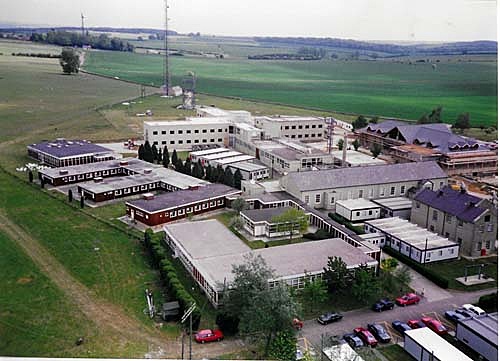
Leafield Radio Station: Birds Eye View of new 1989 developments
Men shovelling snow. Leafield's elevated position was advantageous for radio transmission but not for winter weather. Winter 1963. During this time the Nissan hut was used as works canteen
Leafield s elevated position was advantageous for radio transmission but not for winter weather. Winter 1963. During this time the Nissan hut was used as works canteen
Leafields elevated position was advantageous for radio transmission but not for winter weather. Winter 1963. During this time the Nissan hut was used as works canteen. Men shovelling snow.
Leafield Radio Station: Hostel and Welfare Block 1989
Leafield Radio Station: Training group 1989, with Bryan Hunt, instructor
Typical room in redeveloped student block 1989
Rigging training was transferred from Rugby in 1986 and Leafield s expertise in external rigging and working practices was unique in the UK, if not in Europe also. Students came from as far away as the USA and the Far East for training.
Rigging training was transferred from Rugby in 1986 and Leafield s expertise in external rigging and working practices was unique in the UK, if not in Europe also. Students came from as far away as the USA and the Far East for training. Dave Gibson, instructor, on left
Rigging training was transferred from Rugby in 1986 and Leafield s expertise in external rigging and working practices was unique in the UK, if not in Europe also. Students came from as far away as the USA and the Far East for training.
East Wing converted to student accommodation Phase 1 1986. Photo 1989
East Wing converted to student accommodation Phase 2 1989. Photo 1989
Leafield Radio Station: Birds Eye View of new 1989 developments
Leafield Radio Station: Birds Eye View of new 1989 developments
Leafield Radio Station: Birds Eye View of new 1989 developments
Leafield's elevated position was advantageous for radio transmission but not for winter weather. Winter 1963. During this time the Nissan hut was used as works canteen
Leafield Radio Station: The massive original masts were replaced by smaller ones which covered fields surrounding the site.
Leafield Radio Station: The massive original masts were replaced by smaller ones, including log periodic antennas (shown right) which covered fields surrounding the site
Radio station transmitter wings being converted into student bedrooms
Radio station transmitter wings being converted into student bedrooms
Leafielld Radio Station: Framework of the restaurant building, sited over the area of the cooling ponds
Framework of the restaurant building, sited over the area of the cooling ponds
Leafield Radio Station: Bridge over cooling ponds from car park to the reception area 1988
Leafield Radio Station: The reception desk in the 1980s redevelopment
Leafield Radio Station: New building opened by Stephen Jeffares
Leafield Radio Staion 1980s: Bridge from car park to reception
Leafield Radio Station 1980s: Restaurant/Bar service area in the new 1980s building
Leafield Radio Station 1980s: Bar in the new 1980s building
Aerial view showing new resaurant building over the cooling pond area
Aerial view showing the site before the building of the new restaurant and service area
Steam driven turbine offering constant power to the site
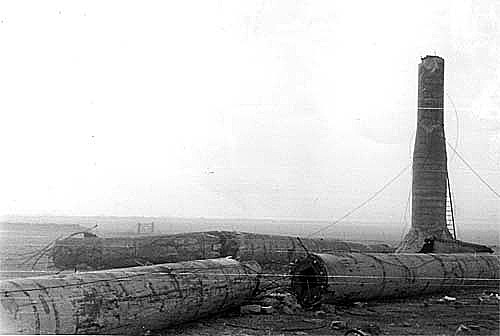
Leafield Radio Station. Shows transmission connections after mast demolition
Leafield Radio Station bolted steel sections of mast
Leafield Radio Station Cooling Ponds 1989
Leafield Radio Station . Failed mast demolition
Power house for boilers and steam turbines. Building on right contatined long wave arc transmitters. Cooling ponds in foreground
Leafield Radio Station. Interior ladder entrance to climb mast
Leafield Radio Station. Masts encased in concrete
Leafield Radio Station : Shows how poles were adapted to make encasing possible
Leafield Radio Station Shows Transmission Connections after mast demolition
Leafield Radio Station Complete Site, 1920s
Moment of demolition of a redundant mast
Leafield Radio Station: Engine power
Leafield Radio Station: One of two 16 cylinder Lister blackstones
Replacement diesel driven generator.Used as standby power in the event of mains failure
306 feet mast with crows nest, 1920s
Men hauling on ropes, presumably as part of the mast raising/Installation?
Mast after demolition - partially successful
Leafield Radio Station - Early bungalow accommodation, still in use in the 1980s
Leafield Radio Station - Night time view poss 1920s
Leafield Radio Station Bungalows 1989
Leafield Radio Station: Christmas Card 1935
Leafield Radio Station: Groundwork for 1961 redevelopment
Leafied Radio Station: Illustration of stony ground during 1961 rebuild
Leafield Radio Station: Groundwork for April 1961 redevelopment
Feb 18th 1961 Groundwork Redevelopment
Conversion of East Wing with Boilerhouse extension 1989
Conversion of East Wing with Boilerhouse extension 1989
Leafield's elevated position was advantageous for radio transmission but not for winter weather. Winter 1963. During this time the Nissan hut was used as works canteen
A History of the Site by British Telecom
Here we offer a downloadable PDF with summary of the notes by British Telecom in the late 1980s, which are also part of the archive folder on loan to WLHS by former employee Bryan Hunt. The summary covers the story up to the late 1980s.
Go here for a 3 minute British Pathe newsreel of a tour around the Post Office Radio Station at Rugby, showing similar features to the station at Leafield (opens in new window)
Go here for a short 30-second clip of the 1921 opening of the station at Leafield (opens in new window)
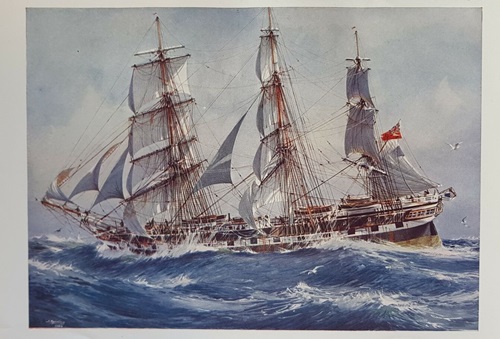
In November the Wychwoods Local History Society are organising and participating in a number of events to commemorate the 150th Anniversary of the Cospatrick Tragedy.
• An exhibition of historic photographs, posters and newscuttings relating to the Cospatrick story in the Wychwoods Library, Milton, open from 4th November until mid December.
• The Society website has a new “Cospatrick Resources” page here with information about the Cospatrick story and links to many other sources of information relating to the Cospatrick and emigration from 19th Century Britain.
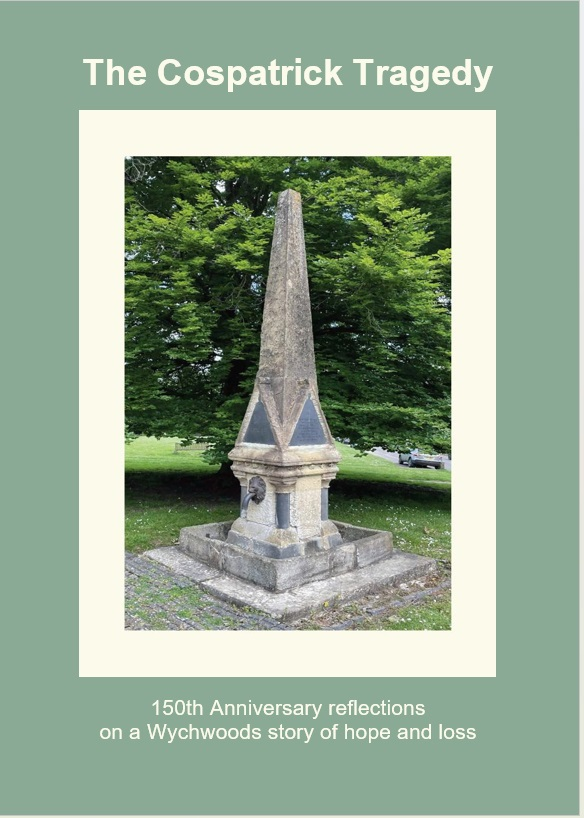
• The Society have compiled a new booklet giving an account of the Cospatrick story, and its place in Wychwoods history. This booklet has been generously sponsored by Simon Randall and Shipton Parish Council. The booklet will be available from 9th November.
The Cospatrick Memorial on Shipton under Wychwood Village Green features on the booklet compiled by the society for Shipton Parish Council. Photo by Diane Melvin
• The Society’s evening Talk on 13th November is themed around the Cospatrick story. Talks by Carol Anderson and John Bennett will recount the story and its context as an episode in 19th Century emigration.
The evening will include a short audio recording of a dramatic emigration episode by former Society stalwart Duncan Waugh, and Jim Pearse will perform a poem on emigration that he first gave for the Society in 1990.
• Members of the Society are also contributing to the Oxfordshire Local History Society’s Study Day on emigration, This will be held at Burford Baptist chapel on 9th November, booking essential, further information here: [PDF Download in new window]
• There will be a memorial service at the Cospatrick Memorial on Sunday 17th November, at 11.15am, led by the vicar Sarah Sharp. The 17th November is the actual 150th Anniversary of the Cospatrick fire. This will be followed by a service at Shipton Parish Church.
Here is an article by Carol Anderson written to accompany an exhibition of photographs currently on show in the Wychwoods Library in Milton.
Carol’s review – available to download here – covers the varying cricketing activities in Ascott and Milton as well as the successes enjoyed by Shipton teams over the years.
Cricket has been played in the Wychwoods since at least the mid-19th century. Jackson’s Oxford Journal records a match between Shipton and Ascott, played on 24th August 1861 (Shipton scored 89, Ascott 35).
Shipton Cricket Club: Historic Moments
The Shipton Cricket Club website records that it is believed that village matches were staged in a field on the edge of Shipton near Fiveways. This is the junction of Leafield and Swinbrook Roads, Mawles and Plum Lane.
The club also records that country house cricket was played on the present ground in the late 19th century. This was made possible by the levelling and draining of the area by the Pepper family. This family were the owners of Shipton Court, which locals will know, stands opposite Shipton’s cricket ground.
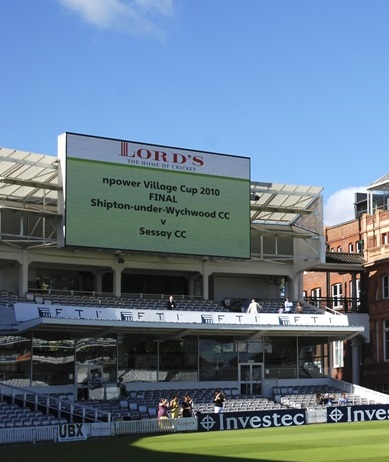
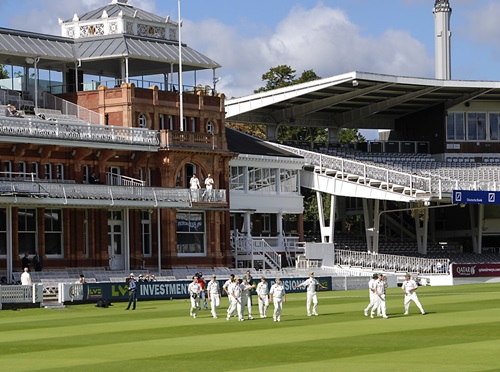
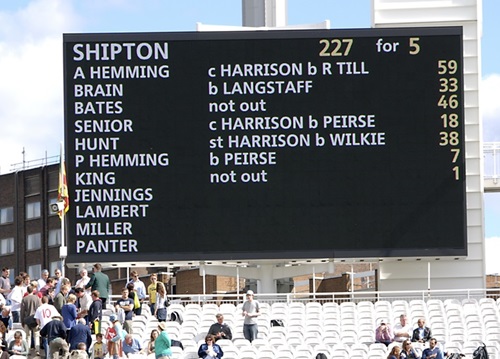
A historic timeline of Shipton Cricket Club appearson the club website here. This includes links to videos of some of the early 21st century games played by Shipton Cricket Club at Lord’s.
The club first entered the National Village Knockout Competition in the mid-90s , reaching the final in 1997.
Sam Mendes, who was a regular player at this time, hosted a meal for the team at the Groucho Club on the eve of the match. In the event the final is overshadowed by the overnight death of Princess Diana. There are doubts about proceeding with the match but it goes ahead. The result was a defeat to Caldy of The Wirral.
Here is a video of pre-match interviews, and many slices of action from the match.
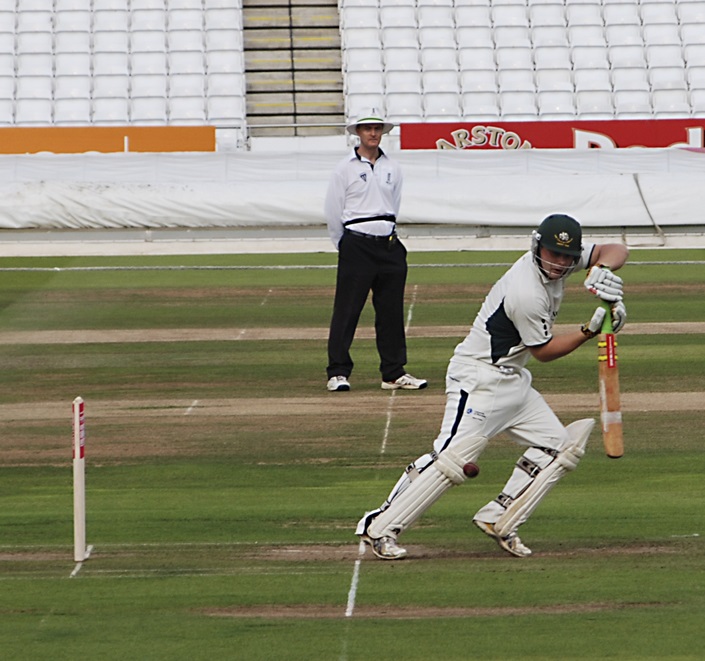
.. and here are some images from Shipton’s later visit to Lord’s in 2010:
Here is an article by Carol Anderson written to accompany an exhibition of photographs recently on show in the Wychwoods Library in Milton
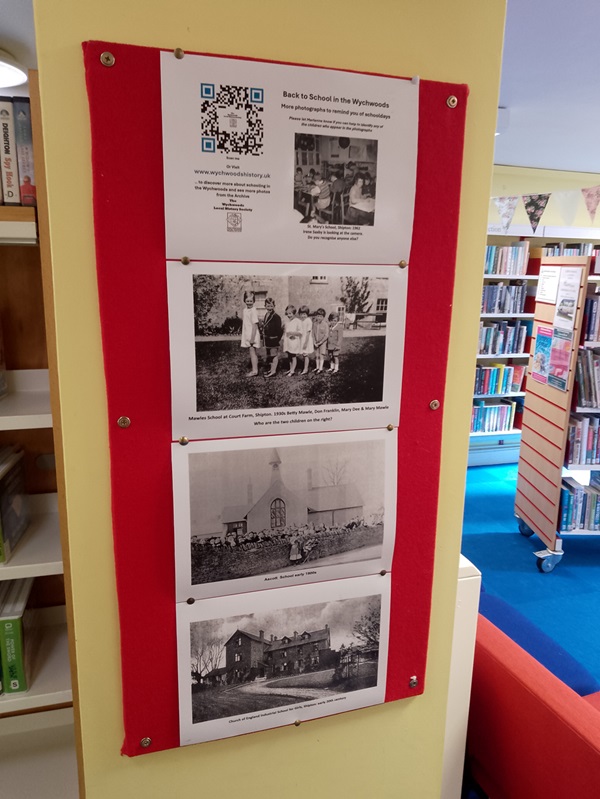
Our library exhibitions continue to highlight some of the fascinating images in our archive. This exhibition featured an interesting set of photos of Wychwoods children at school in the mid 20th century.
We invite you to recognise some of the individuals in these pictures!
Perhaps you might even be one of them?
Education in the Wychwoods
In the Wychwoods, private education sporadically existed from at least the 18th century. Anglican and Nonconformist churches ran Sunday Schools, teaching reading but not writing. Gradually, industrialists championed mass education as crucial for maintaining the nation’s manufacturing edge.
Yet, not everyone agreed. Some feared that widespread education would discourage people from performing essential agricultural work, leaving others hungry. Fortunately, this fear did not prevail. For over 120 years, each of the three Wychwood villages—Ascott, Milton, and Shipton—had its own school.
These schools received support from local benefactors. Board schools, established by the 1870 Education Act, offered non-denominational education, while National schools adhered to Church of England teachings.
Read the full story in Carol’s review, either online here by downloading the article to read later.
We use cookies on our website to give you the most relevant experience by remembering your preferences and repeat visits. By clicking “Accept”, you consent to the use of ALL the cookies.
This website uses cookies to improve your experience while you navigate through the website. Out of these cookies, the cookies that are categorized as necessary are stored on your browser as they are essential for the working of basic functionalities of the website. We also use third-party cookies that help us analyze and understand how you use this website. These cookies will be stored in your browser only with your consent. You also have the option to opt-out of these cookies. But opting out of some of these cookies may have an effect on your browsing experience.
Necessary cookies are absolutely essential for the website to function properly. This category only includes cookies that ensures basic functionalities and security features of the website. These cookies do not store any personal information.
Functional cookies help to perform certain functionalities like sharing the content of the website on social media platforms, collect feedbacks, and other third-party features.
Performance cookies are used to understand and analyze the key performance indexes of the website which helps in delivering a better user experience for the visitors.
Analytical cookies are used to understand how visitors interact with the website. These cookies help provide information on metrics the number of visitors, bounce rate, traffic source, etc.
Advertisement cookies are used to provide visitors with relevant ads and marketing campaigns. These cookies track visitors across websites and collect information to provide customized ads.