An article from Wychwoods Local History Society Journal No.16 pp 28-32 by Keith Chandler , reproduced here as a focus for the May-September 2026 “Dancing Days” Library Exhibition in Milton under Wychwood.
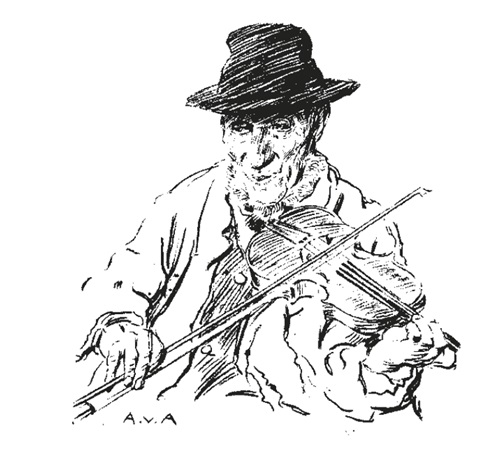
In 1925 the Travelling Morrice, a revivalist dance team based in Cambridge, were touring in the Cotswolds when they encountered a ‘Mr Langshaw’ at Chipping Norton. He revealed that he had formerly played the fiddle to accompany morris dance sides at both Shipton under Wychwood and Milton under Wychwood.1
The recorded history of Milton’s morris dance team dates back to around the 1780s, while that of Shipton is confirmed only from about the 1830s onwards. In an unpublished manuscript compiled in 1885 or earlier, John Horne gave a long account of the annual ‘Jubilee’ (i.e. Whitsun Ale) held at Milton under Wychwood about 1780, ‘where Morris Dancing was one of the chief attractions, as many as three sets would attend there and prizes were given to the best dancers’.2 Given that morris dance sides were always a feature of Whitsun Ale celebrations at this date, one can assume that one of the attendant dance sides would have been local. Morris dancing was a feature of the festivities held to celebrate the marriage of the Prince of Wales in March 18633 and, again, this seems likely to have been the village-based set.
It was probably the first half of the nineteenth century to which Horne referred when he noted ‘Shipton in Oxfordshire was formerly a very noted place for Morris-dancing, as many as four sets have been seen to attend the Club there, and some come from long distances.’4 Henry Franklin, a dancer at Leafield who left the village in 1858, remembered that there had been sets of dancers at Shipton and Milton under Wychwood, and Finstock, and was perhaps recalling sides which were contemporaneously active with his own. He claimed ‘Shipton [was] a lad’s morris, one man whistled to ‘em’, suggesting perhaps a younger side which remained after the set of older men had given up.5
It may have been this latter side for which ‘Mr. Langshaw’ had played. Given the complete absence of biographical details in the Travelling Morrice records, the first task was to identify Mr Langshaw. The 1925 Register of Electors for Chipping Norton recorded no-one by the name of Langshaw but listed the following inhabitants called Longshaw:
| James | 2 Goddard’s Lane |
| Francis, Julia & Ethel Annie | 31 New Street |
| Henry & Amelia | 15 Middle Row |
| Arthur & Grace | 62 West Street |
This offered four possibilities. If, as claimed, he had played for the dance sets at both Shipton and Milton there was a good chance that he had been resident in one of those adjacent villages. From the 1881 census only one household featured any of the 1925 names. The enumeration entry was as follows:
| Name | Age and Occupation | Place of Birth |
| James Longshaw head | 62 Chelsea Pensioner | Leafield |
| Elizabeth wife | 56 | Sunderland, Durham |
| James son | 22 carpenter | Shipton |
| Jane A daughter | 25 | Sunderland, Durham |
James the younger is the most likely candidate for the fiddle player. Parish registers revealed that James Longshaw was baptised at Shipton under Wychwood in July 1858, the son of James and Elizabeth Longshaw. His father’s occupation is described as ‘Soldier (retired)’. In time the family would also include Phoebe and Elizabeth, both born in Shipton.
By the 1891 census, James was a carpenter aged 32 and the Shipton under Wychwood marriage register in May 1891 records his marriage as a bachelor aged 40 to Sarah Longshaw, daughter of Joseph Lanfear.
The official sources reveal only a bare outline of his life. Already, by James’ birth in 1858 his father had retired as a professional soldier on a pension, and continued to receive payment until the age of 72, at least. His unit, given as ‘1st 3rd Foot’, may probably be identified as the First Battalion of the Third Regiment of Foot, otherwise the East Kent Regiment, known since 1782 as The Buffs. As a soldier in this unit he may well have seen action in India during the Gwalior Campaign of 1843,6 a far cry from his native Oxfordshire. His wife and first child were born in Sunderland, in County Durham. At some point between the birth of daughter Jane Ann and son James, the family had moved to Shipton under Wychwood. At this time the forest itself was being cleared extensively under the 1857 Act of Disafforestation. In fact, if the elder James Longshaw had, as the sources suggest, been away for some time, he would scarcely have recognised the region of his birth.7 So, we may observe that James Longshaw, the fiddle player, was brought up in what was, for the place and period, a relatively cosmopolitan household. Not only had his father travelled well beyond the bounds of his home area, but his mother, born in the north-east of the country, would have spoken with an accent uncommon in the Wychwood region.
In 1871 James was enumerated as ‘Scholar’. It was rare at this date for a boy to remain at school much beyond the age of twelve, and at some point during the next decade he became a carpenter and he continued in this trade through 1891 and, in fact, until retirement. He lived with his parents until at least the age of 32, and probably until the date of his marriage in 1898. From the entry in the marriage register his wife’s surname differs from that of her father; further research showed she had been married before. There is no record yet found of James’ death.
My next informant was Mr W F Martin, in Iffley, Oxford. ‘The fiddler? We’ve come across him on my wife’s side. (She) knows of a fiddler at Shipton under Wychwood. ”Jimmy” she remembers him as. She seems to have a childish, vague memory of an old gentleman’. Here, at last, was confirmation that the identification of ‘Mr Langshaw’ as James Longshaw had been correct. He would have been of an age to have played during the 1870s but probably not much before this.
There was also a hazy memory among other family members of James Longshaw having been known locally as a fiddler who apparently played for dancing although not specifically morris dancing. Mrs Martin’s sister, Mrs G B Farrar in Kirtlington recalled seeing a volume of music written by James Longshaw which at one time was in the possession of Mrs Truman, a daughter of Sarah Longshaw, who lived in Hurst Street, Oxford, for many years. Using the parish registers the Martins had drawn up a family tree.
George Longshaw (1856-97) had married Sarah Landfeare (sic), who died in April 1916, and this couple were Mrs Martin’s grandparents. They had three children, two girls and one boy. The son, George Henry William Longshaw (1888–1954) was her father, and her mother was a Stroud, who were a ‘big family’ in the Wychwood area. After George Longshaw’s death Sarah remarried, to James Longshaw. Given Sarah’s death in 1916, Mrs Martin’s memory of James Longshaw would have been when she was ‘very small’, aged about four or five. It is possible to confirm that Sarah Longshaw, daughter of Joseph Lanfear, had remarried to James Longshaw a year after the death of her first husband.
Was it possible that the manuscript tune book belonging to James Longshaw might still exist? Mrs Farrar thought that James Longshaw probably did play for the morris dancers. He did have a music book, but she was only aged about five at the time she remembers seeing it, in about 1915. He also had an old violin hanging on the wall of ‘granny’s kitchen’.
She remembered a cottage on the Bruern Estate, where James was employed as a carpenter. ‘We called him Grampy Jim because we knew he wasn’t our real grandfather’ being her grandmother’s second marriage. Longshaw was considered to be fairly well up in the servants’ hierarchy. The estate carpenter and the stud groom had facing cottages. ‘Grampy Jim had a very nice workshop, away from the house. He was the only carpenter on the estate, and did all the carpentry there, as well as making bits of furniture for the kitchen, if another bench was needed for example.’ She thought that he had a beard; the two sisters used to try and curl it while sitting on either side of him after supper.
At the time she had never encountered beards before, her own father being clean-shaven. James was very good to the two sisters, they used to play in the workshop amongst the shavings and thought it great fun. Mrs Farrar’s mother had gone to Bruern to act as a nurse to Granny when she was dying of cancer, and she and her sister went along. They were there several weeks. While her grandmother was dying the two sisters used to sit on the landing and listen to the conversation below, trying to find out what was happening. They heard something about Grampy Jim going into the workhouse. She did not know whether this was true or not.
At the time she remembers it, the music manuscript was covered with sheepskin, was very smelly and dirty, and was ‘going sticky’, which made her loath to touch it. It was quite a thick book, with the pages a bit like vellum. It was definitely a hand-written manuscript, as she recalled having taken a look at a page or two. Mrs Farrar did not know what had happened to either the violin or the manuscript book
It seems from Mrs Martin’s and Mrs Farrar’s evidence that James Longshaw had played for dancing other than morris, given that he had such an substantial tune collection. Certainly, the village benefit societies continued to celebrate their particular feast days until the end of the nineteenth century and beyond, and dancing remained a common, if not ubiquitous feature.
We may never know what prompted him to take up the fiddle, at what age, whether or not he had a formal teaching, how he acquired the tunes which he committed to paper and what prompted him to choose those in particular, how much he earned from music making, and a score of other questions. Despite failing to locate the music manuscript, which would certainly have been a find of the greatest importance, stories and memories in the family oral tradition had illuminated at least some aspects of the life of yet another working man otherwise destined for obscurity.
References
1 The log of the Travelling Morrice, 1925 (unpublished manuscript), interview with Mr Langshaw (sic), Chipping Norton, Oxfordshire; cited in Twenty-fifth Anniversary booklet, Cambridge Morris Men, 1949, p19.
2 John Horne MSS., Chipping Campden, Gloucestershire, complied 1885 or earlier. There is a typescript copy in the possession of David Hart, Chipping Campden, Gloucestershire, and a copy of the Hart copy in the author’s collection. For details of the chief recurrent features of the Whitsun Ales see Keith Chandler, Ribbons, Bells and Squeaking Fiddles: the Social History of Morris Dancing in the English South Midlands, 1660–1900, Enfield Lock: Hisarlik Press, for the Folklore Society, 1993, Chapter 4.
3 Jackson’s Oxford Journal, 14 March 1863, p8, and Oxford Chronicle, 21 March 1863, p2.
4 Horne, op cit
5 Cecil Sharp MSS, Vaughan Williams Memorial Library, Cecil Sharp House, Camden Town, London. ‘Field notebook (words)’ 4 (17 December–[blank] 1910), interview with Henry Franklin of Leafleld, in Oxford, 1910. Fair copy in ‘Folk Dances’ 1, ff.258-26 1.
For biographical details of the known performers in these named sides see Keith Chandler, Morris Dancing in the English South Midlands, 1660–1900. A Chronological Gazetteer (Enfield Lock: Hisarlik Press, for the Folklore Society, 1993).
6 I am indebted to Dave Parry, melodeon player extraordinary and military historian employed at the Imperial War Museum, for this information.
7 Keith Chandler, ‘Wychwood Forest: A study of the effects of enclosure on the occupational structure of a group of Leafield workers’, Oxfordshire Local History 3, number 5 (Autumn 1990), pp209–220; and Kate Tiller (ed), Milton and Shipton in the Nineteenth Century, a special issue of Wychwoods History No. Three (1987).
Article from Wychwoods Local History Society Journal 16 pp 28-32
The article is also available as a PDF for download here: