Leafield Radio Station: A Century of Innovation and Communication
Across a hundred years, Leafield Radio Station evolved from scientific curiosity to imperial linchpin, from education powerhouse to pit-lane thrill machine. Its buildings may fall silent, but its story continues to transmit through those who remember and retell it.
Leafield Radio Station: 1988 redevelopment
Here we offer a brief summary of the history of the site from the early 20th century. Much of the material here is taken from the records in an archive folder on loan to WLHS by former employee Bryan Hunt. We also include an album of photographs taken from the folder, as well as a pair of interesting video clips from British Pathé.
Leafield Radio Station : Pioneering Beginnings (1912–1918)
In 1912, the visionary Marconi company selected Leafield’s high elevation for experimental radio transmissions under the Post Office’s guidance.
Before this, the site hosted humble meteorological huts — clues to its scientific potential.
With the outbreak of WWI, operations paused, but the site’s significance earned it military protection.
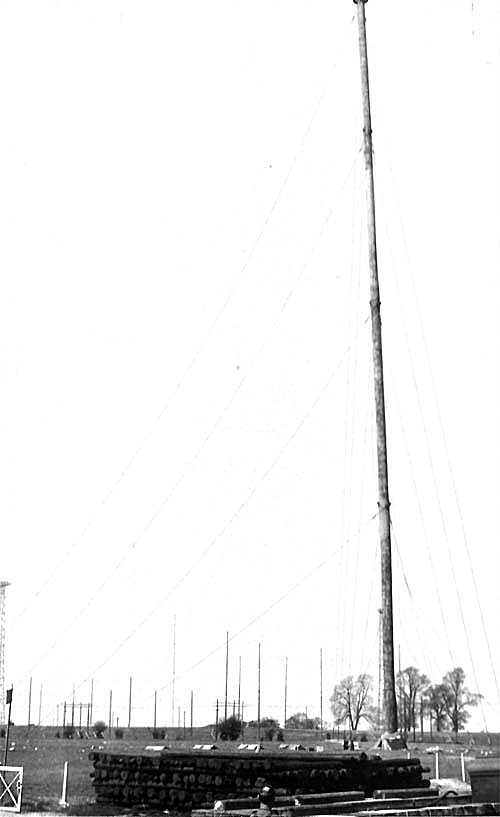
305-feet mast with crows nest, 1920s
The Imperial Wireless Chain (Post-WWI–1940s)
After the war, Leafield joined the ambitious Imperial Wireless Chain to link the British Empire via radio telegraphy.
Thirteen 305-ft masts were erected using a ladder-hoisting method that tested the mettle of early engineers.
By 1943, weather damage and steel shortages led to the masts being encased in concrete, boosting their weight to 120 tons.
Leafield became a hub for Reuter press, maritime, and government radio transmissions.
Leafield Radio Station. Masts encased in concrete.
Powering Progress
To support its high-voltage transmitters, Leafield built a coal-fired power station with twin 800HP steam turbines.
The ash produced formed the “ash track” road — still locally referenced today.
The site grew from 152 to 600 acres, with much of the land leased for aerial fields and sheep grazing.
Wartime Ingenuity & Camouflage
During WWII, buildings were camouflaged and a plywood decoy erected nearby to fool enemy aircraft.
Troops and local Home Guard units guarded the station continuously.
In 1982, Leafield served again during the Falklands War as a long-wave communications link.
Leafield Radio Station: A New Era (1961–1986)
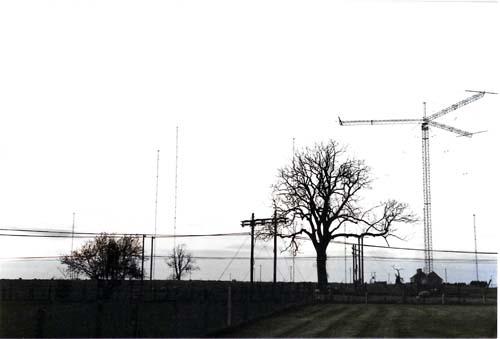
Leafield Radio Station: The massive original masts were replaced by smaller ones which covered fields surrounding the site. On the right is an example of the rotatable log periodic antenna system used.
A modern £1M radio station rose in 1961 with futuristic buildings, 80 steel masts, and automated technology.
Opened in 1962, it was hailed globally as one of the finest.
By 1986, satellite communication had rendered it obsolete, and the station closed. BT Group acquired 12½ acres in 1988.
Leafield Training College (1960s–1994)
Training began soon after the station’s modernisation, with hostels and lecture spaces created from repurposed buildings. Hostel with 50 bedrooms built; unused engineer bungalows used as annexes.
The college expanded with the Red Corridor wing, welfare block, and dining facilities.
Leafield Radio Station: Hostel and Welfare Block 1989
By 1986, East Wing included 38 modern en-suite bedrooms. Training evolved into satellite systems, submarine cable platforms, rigging expertise and AXE test beds.
In 1988, BT Group approved a £5.5M transformation, completed in 1991 — but despite optimism, the site was closed in 1994 as BT restuctured its training systems.
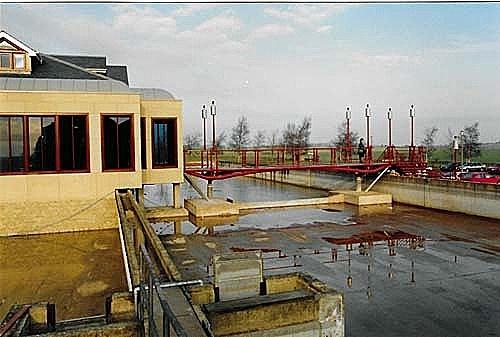
Leafield Radio Station: Bridge over cooling ponds from the car park to the reception area-1988
Motorsport Activity (2000s–2015)
After BT’s departure, Leafield found new life in motorsport.
Leased to Tom Walkinshaw Racing (TWR) as a Formula One development hub for Arrows F1 until 2002.
From 2006–2008, Super Aguri F1 operated from the site.
Menard Competition Technologies (MCT) joined next, producing engines for Norton Motorcycles’ Commando 961 range from 2009.
In 2012, Caterham F1 Team relocated to Leafield, but declared bankruptcy in 2015.
Today, Leafield Technical Centre stands empty — its future uncertain, but its past vibrantly alive.
Former Leafield Technical College July 2025
Leafield Radio Station: A Selection of Images
Here we offer a selection of images from which are also part of the archive folder on loan to WLHS by former employee Bryan Hunt
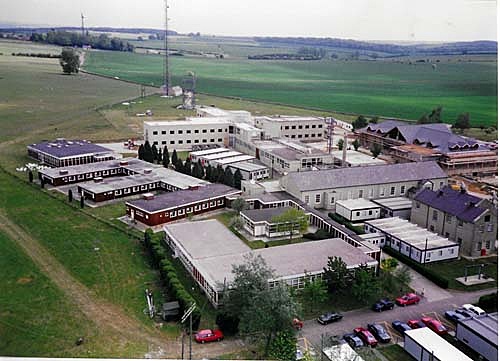
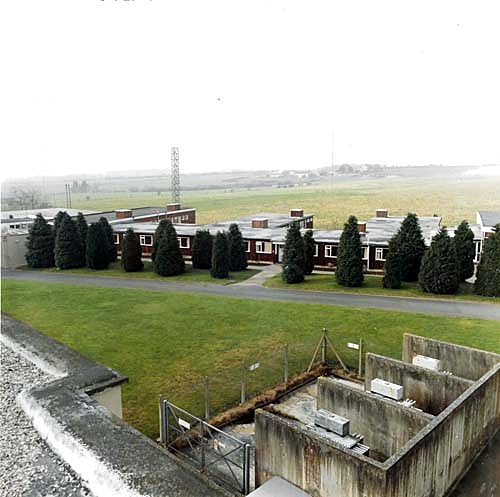
Leafield Radio Station: Birds Eye View of new 1989 developments
Men shovelling snow. Leafield's elevated position was advantageous for radio transmission but not for winter weather. Winter 1963. During this time the Nissan hut was used as works canteen
Leafield s elevated position was advantageous for radio transmission but not for winter weather. Winter 1963. During this time the Nissan hut was used as works canteen
Leafields elevated position was advantageous for radio transmission but not for winter weather. Winter 1963. During this time the Nissan hut was used as works canteen. Men shovelling snow.
Leafield Radio Station: Hostel and Welfare Block 1989
Leafield Radio Station: Training group 1989, with Bryan Hunt, instructor
Typical room in redeveloped student block 1989
Rigging training was transferred from Rugby in 1986 and Leafield s expertise in external rigging and working practices was unique in the UK, if not in Europe also. Students came from as far away as the USA and the Far East for training.
Rigging training was transferred from Rugby in 1986 and Leafield s expertise in external rigging and working practices was unique in the UK, if not in Europe also. Students came from as far away as the USA and the Far East for training. Dave Gibson, instructor, on left
Rigging training was transferred from Rugby in 1986 and Leafield s expertise in external rigging and working practices was unique in the UK, if not in Europe also. Students came from as far away as the USA and the Far East for training.
East Wing converted to student accommodation Phase 1 1986. Photo 1989
East Wing converted to student accommodation Phase 2 1989. Photo 1989
Leafield Radio Station: Birds Eye View of new 1989 developments
Leafield Radio Station: Birds Eye View of new 1989 developments
Leafield Radio Station: Birds Eye View of new 1989 developments
Leafield's elevated position was advantageous for radio transmission but not for winter weather. Winter 1963. During this time the Nissan hut was used as works canteen
Leafield Radio Station: The massive original masts were replaced by smaller ones which covered fields surrounding the site.
Leafield Radio Station: The massive original masts were replaced by smaller ones, including log periodic antennas (shown right) which covered fields surrounding the site
Radio station transmitter wings being converted into student bedrooms
Radio station transmitter wings being converted into student bedrooms
Leafielld Radio Station: Framework of the restaurant building, sited over the area of the cooling ponds
Framework of the restaurant building, sited over the area of the cooling ponds
Leafield Radio Station: Bridge over cooling ponds from car park to the reception area 1988
Leafield Radio Station: The reception desk in the 1980s redevelopment
Leafield Radio Station: New building opened by Stephen Jeffares
Leafield Radio Staion 1980s: Bridge from car park to reception
Leafield Radio Station 1980s: Restaurant/Bar service area in the new 1980s building
Leafield Radio Station 1980s: Bar in the new 1980s building
Aerial view showing new resaurant building over the cooling pond area
Aerial view showing the site before the building of the new restaurant and service area
Steam driven turbine offering constant power to the site
Leafield Radio Station. Shows transmission connections after mast demolition
Leafield Radio Station bolted steel sections of mast
Leafield Radio Station Cooling Ponds 1989
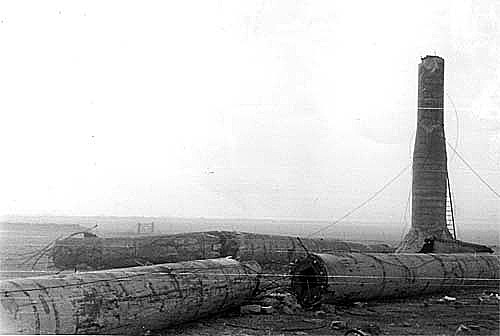
Leafield Radio Station . Failed mast demolition
Power house for boilers and steam turbines. Building on right contatined long wave arc transmitters. Cooling ponds in foreground
Leafield Radio Station. Interior ladder entrance to climb mast
Leafield Radio Station. Masts encased in concrete
Leafield Radio Station : Shows how poles were adapted to make encasing possible
Leafield Radio Station Shows Transmission Connections after mast demolition
Leafield Radio Station Complete Site, 1920s
Moment of demolition of a redundant mast
Leafield Radio Station: Engine power
Leafield Radio Station: One of two 16 cylinder Lister blackstones
Replacement diesel driven generator.Used as standby power in the event of mains failure
306 feet mast with crows nest, 1920s
Men hauling on ropes, presumably as part of the mast raising/Installation?
Mast after demolition - partially successful
Leafield Radio Station - Early bungalow accommodation, still in use in the 1980s
Leafield Radio Station - Night time view poss 1920s
Leafield Radio Station Bungalows 1989
Leafield Radio Station: Christmas Card 1935
Leafield Radio Station: Groundwork for 1961 redevelopment
Leafied Radio Station: Illustration of stony ground during 1961 rebuild
Leafield Radio Station: Groundwork for April 1961 redevelopment
Feb 18th 1961 Groundwork Redevelopment
Conversion of East Wing with Boilerhouse extension 1989
Conversion of East Wing with Boilerhouse extension 1989
Leafield's elevated position was advantageous for radio transmission but not for winter weather. Winter 1963. During this time the Nissan hut was used as works canteen
A History of the Site by British Telecom
Here we offer a downloadable PDF with summary of the notes by British Telecom in the late 1980s, which are also part of the archive folder on loan to WLHS by former employee Bryan Hunt. The summary covers the story up to the late 1980s.
Go here for a 3 minute British Pathe newsreel of a tour around the Post Office Radio Station at Rugby, showing similar features to the station at Leafield (opens in new window)
Go here for a short 30-second clip of the 1921 opening of the station at Leafield (opens in new window)
Cookies on our site
We use cookies on our website to give you the most relevant experience by remembering your preferences and repeat visits. By clicking “Accept”, you consent to the use of ALL the cookies.
This website uses cookies to improve your experience while you navigate through the website. Out of these cookies, the cookies that are categorized as necessary are stored on your browser as they are essential for the working of basic functionalities of the website. We also use third-party cookies that help us analyze and understand how you use this website. These cookies will be stored in your browser only with your consent. You also have the option to opt-out of these cookies. But opting out of some of these cookies may have an effect on your browsing experience.
Necessary cookies are absolutely essential for the website to function properly. This category only includes cookies that ensures basic functionalities and security features of the website. These cookies do not store any personal information.
Functional cookies help to perform certain functionalities like sharing the content of the website on social media platforms, collect feedbacks, and other third-party features.
Performance cookies are used to understand and analyze the key performance indexes of the website which helps in delivering a better user experience for the visitors.
Analytical cookies are used to understand how visitors interact with the website. These cookies help provide information on metrics the number of visitors, bounce rate, traffic source, etc.
Advertisement cookies are used to provide visitors with relevant ads and marketing campaigns. These cookies track visitors across websites and collect information to provide customized ads.