Across a hundred years, Leafield Radio Station evolved from scientific curiosity to imperial linchpin, from education powerhouse to pit-lane thrill machine. Its buildings may fall silent, but its story continues to transmit through those who remember and retell it.
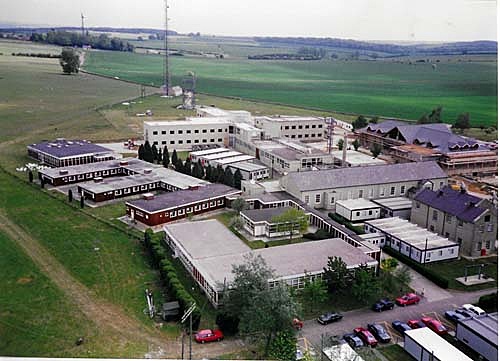
Leafield Radio Station: 1988 redevelopment
Here we offer a brief summary of the history of the site from the early 20th century. Much of the material here is taken from the records in an archive folder on loan to WLHS by former employee Bryan Hunt. We also include an album of photographs taken from the folder, as well as a pair of interesting video clips from British Pathé.
Leafield Radio Station : Pioneering Beginnings (1912–1918)
- In 1912, the visionary Marconi company selected Leafield’s high elevation for experimental radio transmissions under the Post Office’s guidance.
- Before this, the site hosted humble meteorological huts — clues to its scientific potential.
- With the outbreak of WWI, operations paused, but the site’s significance earned it military protection.
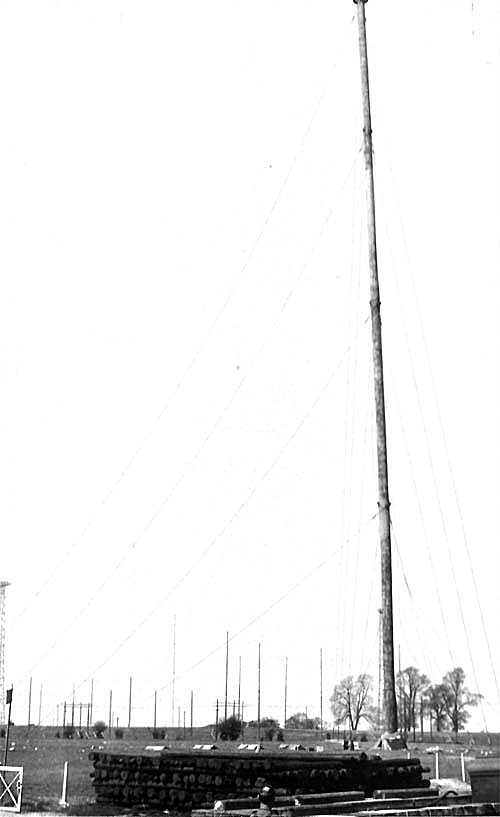
305-feet mast with crows nest, 1920s
The Imperial Wireless Chain (Post-WWI–1940s)
- After the war, Leafield joined the ambitious Imperial Wireless Chain to link the British Empire via radio telegraphy.
- Thirteen 305-ft masts were erected using a ladder-hoisting method that tested the mettle of early engineers.
- By 1943, weather damage and steel shortages led to the masts being encased in concrete, boosting their weight to 120 tons.
- Leafield became a hub for Reuter press, maritime, and government radio transmissions.
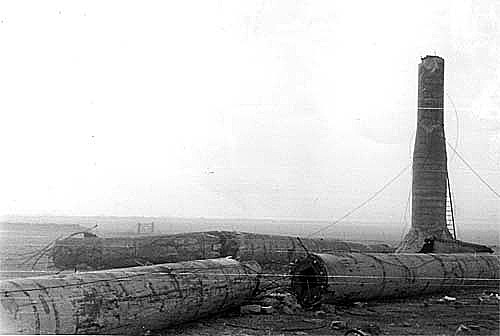
Leafield Radio Station. Masts encased in concrete.
Powering Progress
- To support its high-voltage transmitters, Leafield built a coal-fired power station with twin 800HP steam turbines.
- The ash produced formed the “ash track” road — still locally referenced today.
- The site grew from 152 to 600 acres, with much of the land leased for aerial fields and sheep grazing.
Wartime Ingenuity & Camouflage
- During WWII, buildings were camouflaged and a plywood decoy erected nearby to fool enemy aircraft.
- Troops and local Home Guard units guarded the station continuously.
- In 1982, Leafield served again during the Falklands War as a long-wave communications link.
Leafield Radio Station: A New Era (1961–1986)
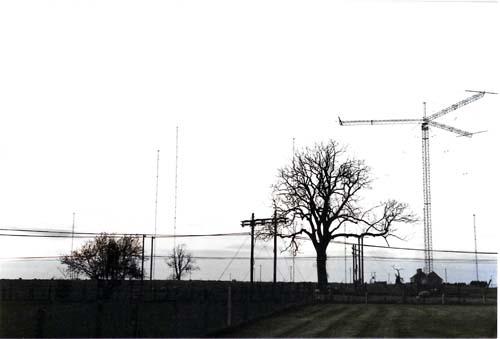
Leafield Radio Station: The massive original masts were replaced by smaller ones which covered fields surrounding the site. On the right is an example of the rotatable log periodic antenna system used.
- A modern £1M radio station rose in 1961 with futuristic buildings, 80 steel masts, and automated technology.
- Opened in 1962, it was hailed globally as one of the finest.
- By 1986, satellite communication had rendered it obsolete, and the station closed. BT Group acquired 12½ acres in 1988.
Leafield Training College (1960s–1994)
- Training began soon after the station’s modernisation, with hostels and lecture spaces created from repurposed buildings. Hostel with 50 bedrooms built; unused engineer bungalows used as annexes.
- The college expanded with the Red Corridor wing, welfare block, and dining facilities.
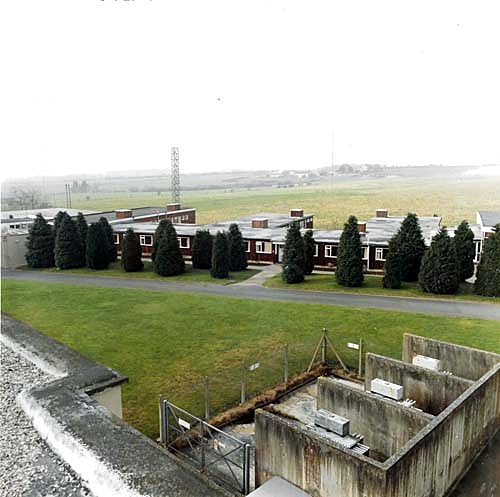
Leafield Radio Station: Hostel and Welfare Block 1989
- By 1986, East Wing included 38 modern en-suite bedrooms. Training evolved into satellite systems, submarine cable platforms, rigging expertise and AXE test beds.
- In 1988, BT Group approved a £5.5M transformation, completed in 1991 — but despite optimism, the site was closed in 1994 as BT restuctured its training systems.
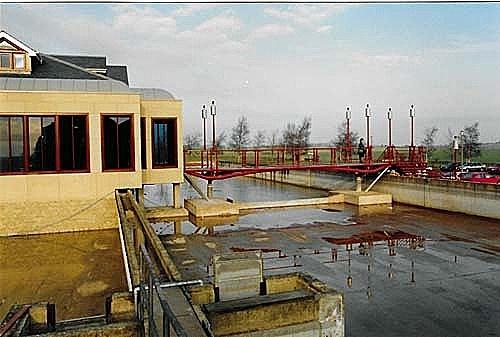
Leafield Radio Station: Bridge over cooling ponds from the car park to the reception area-1988
Motorsport Activity (2000s–2015)
After BT’s departure, Leafield found new life in motorsport.
- Leased to Tom Walkinshaw Racing (TWR) as a Formula One development hub for Arrows F1 until 2002.
- From 2006–2008, Super Aguri F1 operated from the site.
- Menard Competition Technologies (MCT) joined next, producing engines for Norton Motorcycles’ Commando 961 range from 2009.
- In 2012, Caterham F1 Team relocated to Leafield, but declared bankruptcy in 2015.
Today, Leafield Technical Centre stands empty — its future uncertain, but its past vibrantly alive.


Leafield Radio Station: A Selection of Images
Here we offer a selection of images from which are also part of the archive folder on loan to WLHS by former employee Bryan Hunt


A History of the Site by British Telecom
Here we offer a downloadable PDF with summary of the notes by British Telecom in the late 1980s, which are also part of the archive folder on loan to WLHS by former employee Bryan Hunt. The summary covers the story up to the late 1980s.
Video Clips