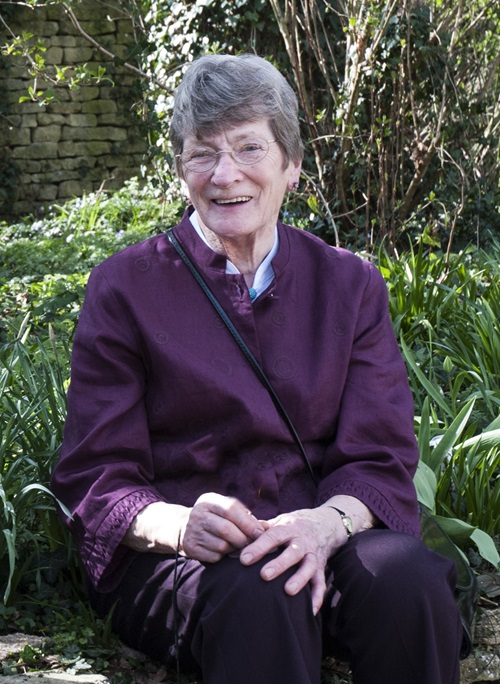
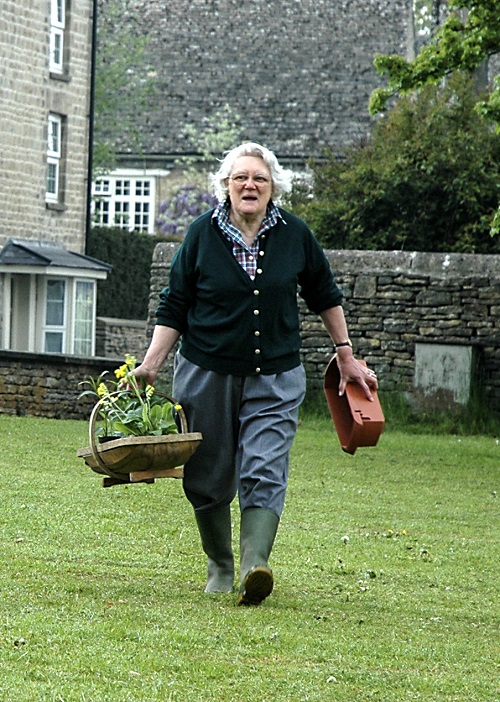
With the death of Janet Wallace in April, the Wychwoods Local History Society, has lost one of the last of the generation still living in the Wychwoods, who created our Society and made it what it is.
For a fuller account of her life written by Trudy Yates, please see Journal 25 here.
Janet was born in Hammersmith, the eldest child of Dr Gordon Scott and his wife Betty. She had two sisters and a brother, Dr Sandy Scott. She worked for a year at the Chipping Norton Memorial Hospital before training as a nurse at the Middlesex Hospital and then doing midwifery training at the Radcliffe in Oxford. While her family was very young, she worked at the Cokethorpe School in the sanatorium and then as a classroom assistant and later secretary at Milton primary school.
She joined her father and brother as a typist/nurse in the Wychwood surgery in 1972 and worked there as practice nurse for 25 years.
She joined the committee of the Wychwoods Local History Society in 1992 and, after 25 years of service, stepped down in 2017. She wrote articles for the annual Journal, especially looking at emigration during the latter part of the 19th century. Janet was a pioneer in carrying out recorded interviews with local inhabitants. She produced many hours of such in-depth recordings, making a priceless contribution to the society’s oral history archive.
For many years she organised refreshments for members at speaker evenings. She manned the Society’s stands at village fetes. As somebody who worked with her on our committee for more than fifteen years, I remember her as an efficient and engaged local historian but someone also prepared to do the humblest of tasks for the good of the membership and to share her wide knowledge of the Wychwoods and its people.
Here is a snippet from one of our many Oral History audio files. In it, former 1920s Shipton Court resident Dorothy “Dor” Thomson tells the apocryphal tale of Mr Samuda and his Model T Ford.
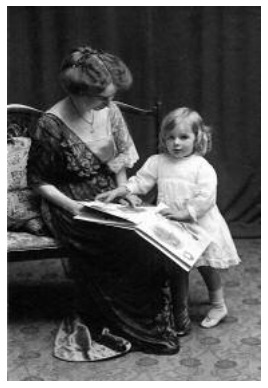
Catherine “Bay” Thomson and her first child Dorothy, known as “Dor”
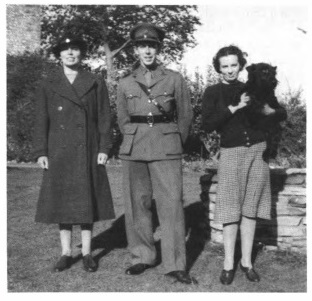
Left to Right: Siblings “Dor”, David and Joan Thomson
Dorothy Thomson with Mary McNeill 2004
Transcript
“Mr Samuda was a great character who at that time lived at Bruern Abbey, and he was well known to all of us because he was a gentleman that always drove about in a cart, a sort of dog-cart with a cob, a nice smart cob, and to everybody’s surprise – it was very early in the twenties – he suddenly bought a T-model Ford which was really quite adventurous ‘cos he was quite an elderly gentlemen at that time. And his stud groom whose name was Tustain was absolutely horrified at this. However, Tustain was told that he had to learn to drive this terrible thing.
And they drove around the roads, the two of them – they could both drive it- and the story went around (I don’t know how true it was) that one day Mr Samuda was driving, and he’d had enough, he got rather bored with it, and he said to Tustain as they were bowling along the road “I’ve had enough of this Tustain, now you can take over”.
And in the old days of course, with carriages, you just passed over the reins to the other man. Well when you’re driving a car it’s not quite as simple as that, so the two of them had to cross over while. – it never occurred to them to stop the car meantime – they had to cross over and fortunately it was a straight road and fortunately they survived, but this story went round the locality for quite some months.”
The Full Interview
In this set of reminiscences, Dororothy Thomson recalls many details and anecdotes from her life as child and growing up at Shipton Court. The 2004 WLHS Journal No 19 [ available here ] contains many excerpts from these memoirs, as well as a summary of her life during and after her time at Shipton Court.
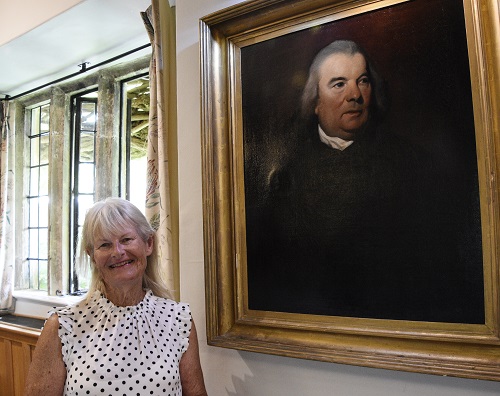
The Reverend Doctor Thomas Brookes was the Rector at Shipton from 1773 to 1814. The story of how his rather powerful portrait came to be returned to Shipton in 2013 was told in the Wychwood Volume 34 number 2 of 2013, and is also available here >>>
Recently the Wychwoods Local History Society heard from a lady called Vicky Sangster who lives in Sydney. She is a direct descendant of Dr Brookes’ daughter and wondered whether it would be possible to see his portrait while she was on holiday in England.
Vicky duly came to Shipton and, although time was tight, we arranged for her to see the portrait in the Prebendal where Dr Brookes formerly lived and St Mary’s where he preached.
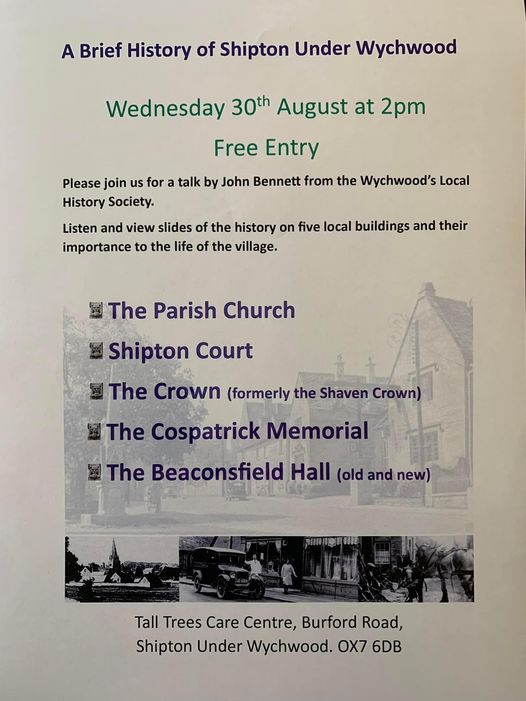
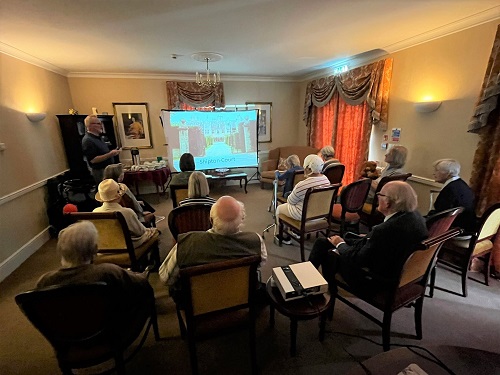
The society was pleased to take up the invitation from the management of Tall Trees care home to give a local history talk for their Coffee Day on August 30th.
Society secretary John Bennett took up the offer. He prepared an informative but light-touch journey through the history of five individual Shipton landmarks, to an audience of residents and family visitors.
His presentation was well received, with plenty of interactive questions and comments from the group. At least one audience member was eager to claim connections with the Reade family of Shipton Court, and others took pleasure in recognising faces from images in John’s carefully-selected set of photographs. There was certainly no shortage of instant and positive feedback!
It was a delight to meet Lil Harmer and staff, whose commitment to the day was clear in the provision of a fine spread of cakes, fruit and copious cups of tea – creating a friendly and sociable occasion for all.
For more than four decades, from the 1960s, Margaret and Frank Ware were energetic contributors to Wychwood society and are fondly remembered by many particularly in the Wychwoods History Society and the WI.
Frank died in 2019 and now the death has been announced of Margaret (neé Williams)
Margaret was born in London in 1933. She gained a first class degree in Botany at Kings College, London and then did postgraduate research into plant biochemistry leading to a PhD in 1962.
She had a keen interest in social justice and current affairs and in 1957 she joined the Liberal party and became chair of the Dulwich Young Liberals. It was through this political interest that she met Frank Ware, whom she married in 1959.
Margaret and Frank rented in London for a couple of years, where Margaret taught, first in a grammar school and then in a technical college, but then they moved to Oxfordshire – first to Milton-under-Wychwood and then to Shipton-under-Wychwood – where Frank stood as a Liberal candidate at the 1964 general election. Margaret gave up work to support his political ambitions, and, when these were cut short, she continued to support him while he pursued an increasingly stressful and demanding career in tax and finance.
In 1965 Margaret gave birth to twins, Fiona and Alison. When they reached the age of eight, she began a 17-year voluntary career in local government – first on Shipton-under-Wychwood Parish Council, and then as an independent councillor on West Oxfordshire District Council, where she became chairman of the Recreation committee, vice-chairman of a Planning sub-committee and also served for one year as vice-chair of the entire council. For ten years she was also a governor of Burford School, which her daughters attended.
Margaret co-founded the Wychwoods Playgroup with a group of local mothers and she was instrumental in raising funds for and ensuring the building of a swimming pool at the Wychwoods primary school.
In 1981 Margaret co-founded the Wychwoods Local History Society, and subsequently edited its journal. She and Frank organised many field walks over several years, which many members of the local villages took part in. Notable finds were prehistoric flint arrowheads, medieval pottery and even fragments from a WW2 crashed aircraft.
Margaret was a member of the Shipton WI and enjoyed performing on stage in some of their pantomimes in the 90’s and early 2000’s. In one performance of a Spice Girls skit, she was Scary Spice dressed in tight fitting leopard skin leggings, and her mother, who was nearing 100 herself at the time, was not amused when shown the costume beforehand, saying, in a horrified tone, ‘You’re not going to go on stage wearing that, are you?’
Between them, Margaret and Frank also contributed significantly to the fundraising efforts for the building of the New Beaconsfield Village Hall.
Margaret and Frank shared a lifelong interest in archaeology and beginning in 1976 she was the District Council’s representative on the Oxford Archaeology Unit’s governing body. In 1992, they both began studying archaeology at Oxford University Department for Continuing Education, eventually being awarded the Oxford Diploma in Archaeology. From 1996 to 2005 Margaret served as chair of the trustees of Oxford Archaeology Unit, which by this time had become one of the three leading professional archaeological businesses in the country with a growing international reputation.
After the death of Margaret’s mother in 2005, Margaret and Frank moved to Leominster to begin a new chapter in their lives, and again got involved with the local community, joining the U3A and many interest groups.
In 2015 she became seriously ill and spent the next nine months on kidney dialysis three times a week. Remarkably, she recovered sufficiently to not need the dialysis and even to regain most of her former physical strength.
Margaret and Frank celebrated their 60th wedding anniversary in February 2019.Then Frank had a stroke in the April and passed away after only a couple of days in hospital.
On 24th June 2023 – four days before her actual birthday – Margaret threw a 90th birthday party for all her friends in Leominster. She had a heart attack on Sunday morning, 2nd July, and was admitted to hospital. She died just six days after her 90th birthday. She is survived by her two daughters, Fiona and Alison, and by four grandchildren, William, Stuart, Becky and Silvia.
Read Margaret’s artice on the society’s first 21 years here
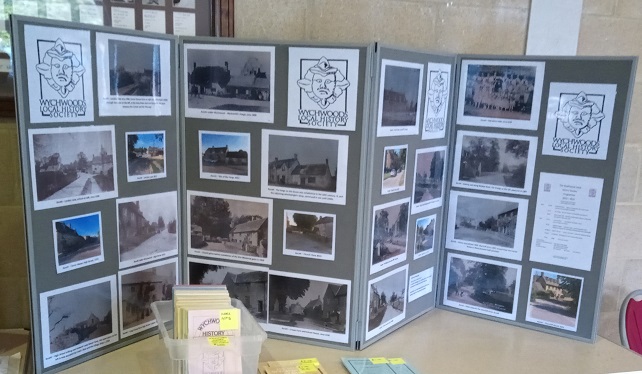
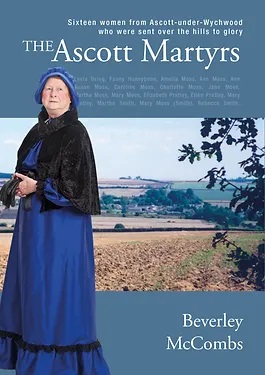
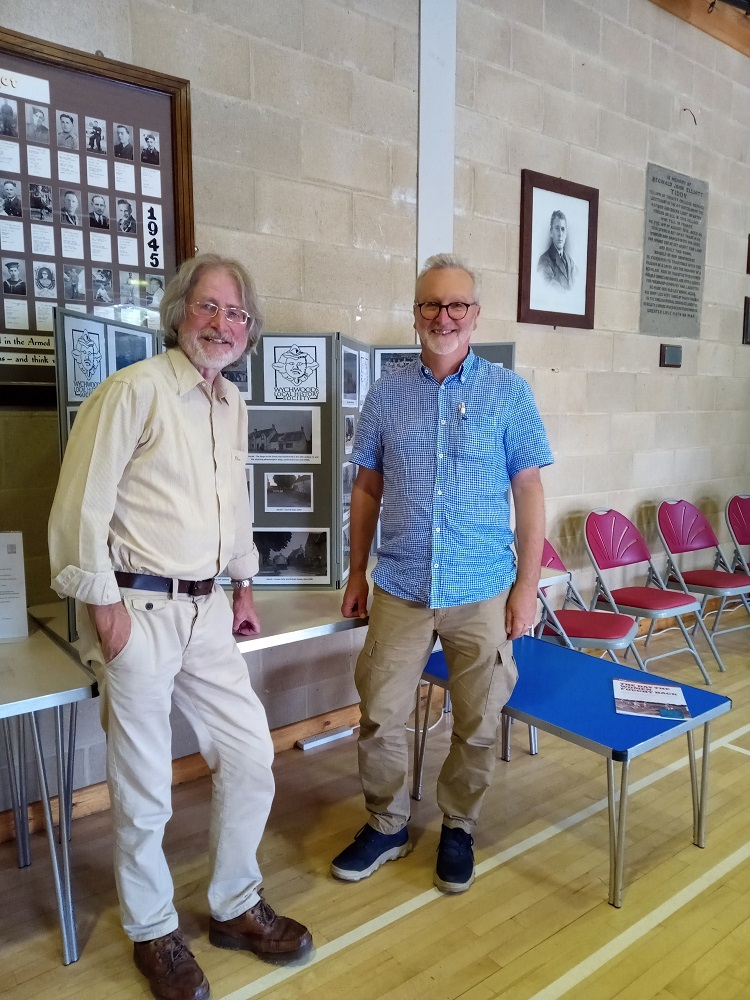
Saturday 17 June saw committee members supporting WLHS colleague Carol Anderson and the Ascott Martyrs Educational Trust’s family and local history day at Tiddy Hall in Ascott under Wychwood.
Sample WLHS Display“The Ascott Martyrs”John Bennett (right) and David Betterton
This was an enjoyable as well as informative opportunity for visitors to discover more about their family history. A major part of the exhibition was the Trust’s amazing Martyrs Family Tree (11 metres long it contains more than 2,500 names). Also on hand was Beverley McCombs whose book ‘The Ascott Martyrs’, introduced us to their family histories.
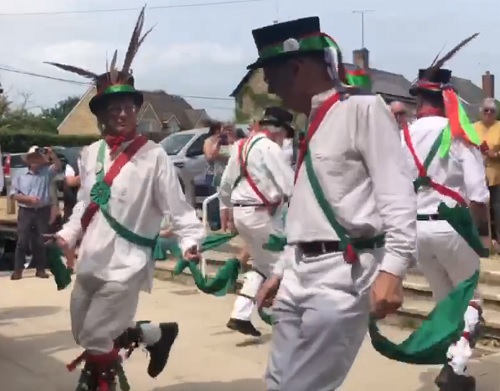
Visitors were also regaled by Charlbury Finstock Morris with a performance which included two of the traditional dances that originated in Ascott. A Facebook clip appears here thanks to Mark Pigeon.
During a recent Wychwoods History Society talk, Chris Pickford, expert in the history of bells and bellringing, made a special mention of the bells at St Nicholas’ Church in Chadlington.
He reminded us of interesting times, when a landowner could bodily remove a village and its inhabitants to improve estate parklands. In this case we have Lord Harcourt of Nuneham Courtenay doing exactly that. In the 1760s, he demolished the church and removed its five bells.
Chris Pickford’s research – featured here on the Wychwoods History website – demonstrates in detail how those five bells, with a sixth added in 1796, are now housed in Chadlington church – a rare early example of a transferred ringing peal of bells.
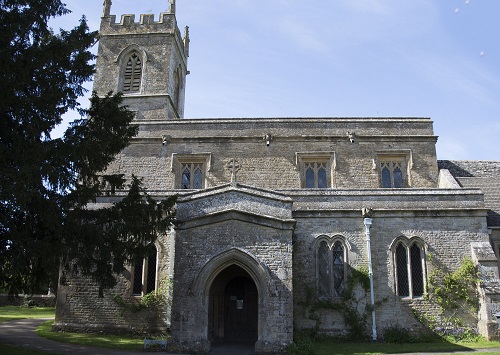
St. Nicholas Church, Chadlinton
In this coronation year with bellringing very much part of the celebrations marking change, it seems apposite to think of stories such as these. There is a rich history hidden in church towers throughout the land, and particularly in the Wychwoods. Bells can be vulnerable – one thinks of the church of St. Peter and St. Paul in Deddington, where all but one of the five bells had been requisitioned by Charles I in 1643 and melted down to be made into artillery!
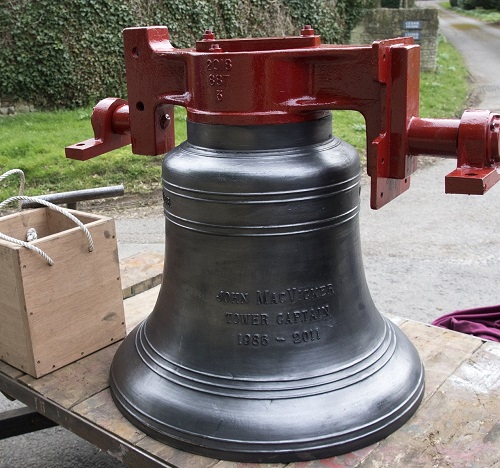
A less dramatic reminder of the need to look after the heritage of bells was the refurbishment and re-hanging of the bells in Shipton in 2019 – an event which brought the community together in fundraising to ensure their future.
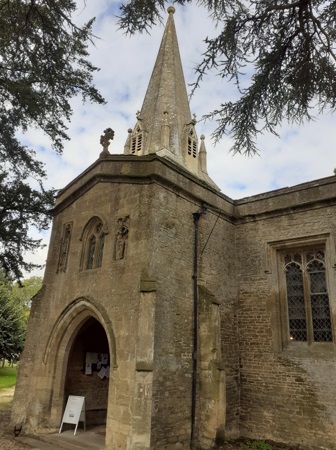
St. Nicholas, Shipton under Wychwood
Shipton Refurbished Bell. The 3rd bell, with inscription JOHN MacVICKER TOWER CAPTAIN 1986 to 2011, was recast and returned on 19th March 2019
Those Shipton bells were worked on by the last remaining bell foundry in the UK, John Taylor and Sons in Loughborough. But moving bells around the country was not always so straightforward. The two 15th-century bells at St. Nicholas Church in Idbury would have been made on site in a casting pit. Medieval transport systems precluded such manufacturing off site.
Bells at Ascott Holy Trinty Church
Ascott Holy Trinity is notable. Five of its six bells were cast in 1744 by Henry Bagley III. The family is important to the history of bellfounding in our area, having established a foundry in Witney and supplying bells for towers in Fulbrook, Witney, Shilton, Westwell and Standlake.
Bells at Fulbrook Church
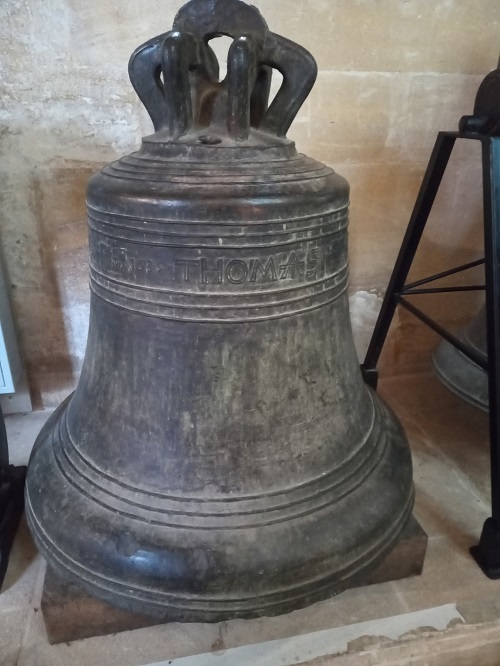
At Fulbrook until 2003 the ring of three included treble and tenor cast in Burford by Edward Neale – of the earlier and equally important bell-founding family. Neale’s Sanctus bell dates from 1649 and is still in use. Once again, village fundraising in Fulbrook allowed a new bell frame to be installed for a ring of six. The original treble now stands in the north aisle of Burford Church – the “bellfounders’ aisle”, beside two other Neale bells.
A Fulbrook Neale Bell at Burford
A single bell one might say, can have mournful overtones. I think of the curfew bell in Gray’s Elegy tolling the knell of parting day. Perhaps also of John Donne’s “never send to know for whom the bell tolls”. This latter is a somewhat ominous expression of the interconnectedness of humankind. This is better and more joyfully expressed by the change-ringing of multiple bells, and perhaps also by the simple “Peace and good neighbourhood” message on the treble bell at Idbury, and on the fourth of Chadlington’s peal of six.
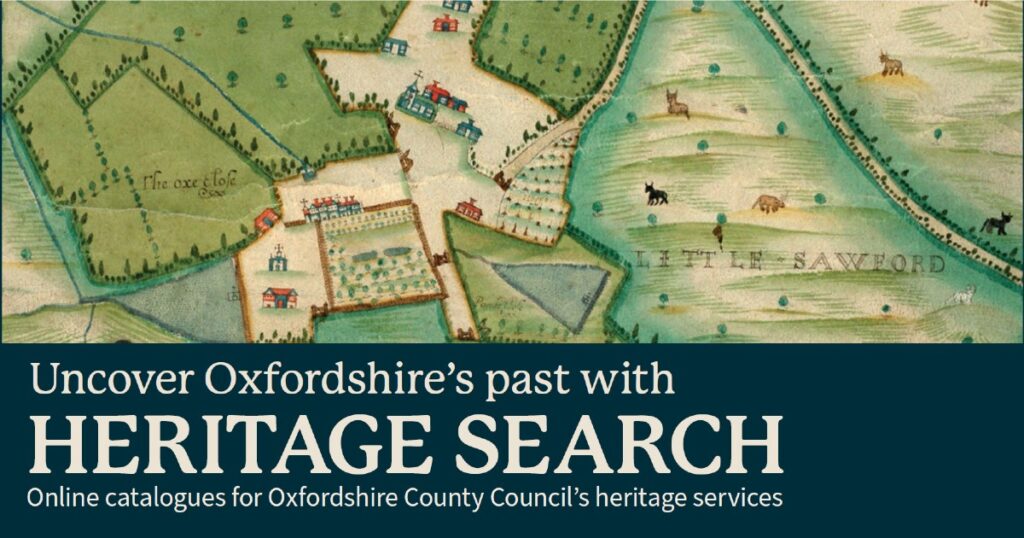
Here is news of a set of free online catalogues from Oxfordshire County Council’s heritage services.
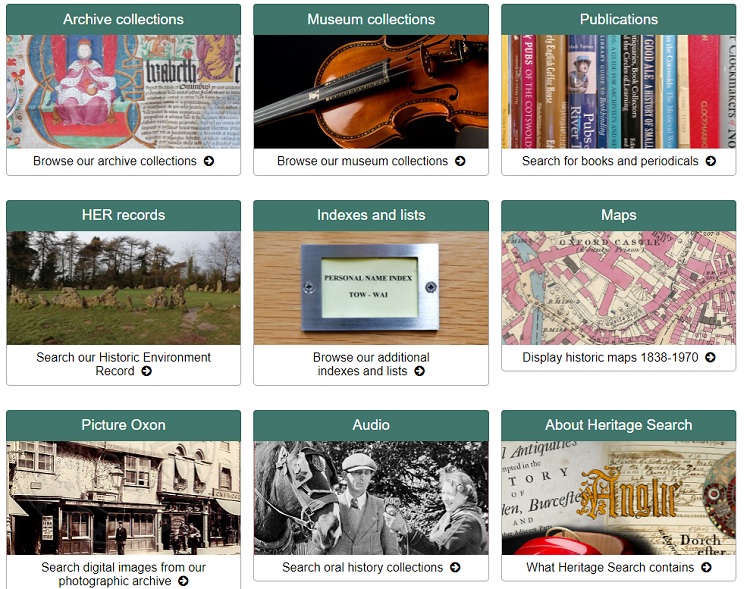
Residents and people interested in the history of Oxfordshire can now uncover more of the county’s rich past with Oxfordshire County Council’s new Heritage Search.
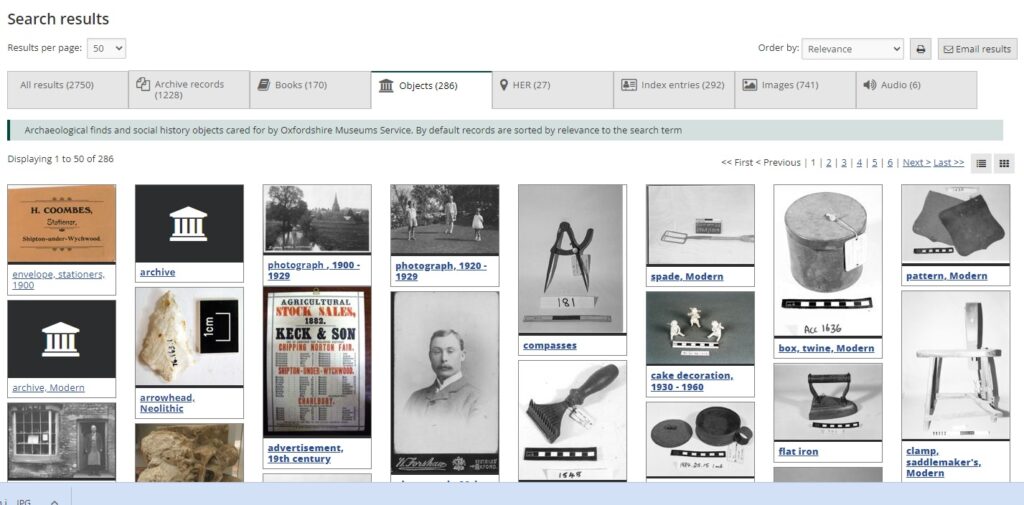
This brand-new resource is free to use and contains a comprehensive catalogue of historical resources, including a wide range of archive documents, books, photographs, maps and much more, relating to the history of Oxfordshire ¬from ancient artefacts to modern-day landmarks.
Whether you are a student, historian, or simply an enthusiast of local history, Heritage Search is your ultimate, free-to-use resource. You can easily find out about items of interest and dive deeper into the fascinating world of Oxfordshire’s heritage.
You can also display historic maps of Oxfordshire and plot many of our heritage assets, like photographs and archaeological finds, on the new mapping platform.
Typical ( small sample) search result for Shipton under Wychwood
Archives catalogue of documents created by local councils and other official bodies, churches, schools, businesses, and individuals; including written records, maps and plans. (12th to 21st century)
Local Studies catalogue of published material, including books, journals, articles, and maps about Oxfordshire people, places and topics
Oral history catalogue of sound recordings, including extracts from Radio Oxford programmes back to 1970, and field recordings made since the 1960s
People & Business indexes of articles relating to Oxfordshire people and businesses, from local newspapers (1791-2011)
Poor Law index of individuals and families named in the Oxfordshire Poor Law records (1601-1891)
Miscellaneous lists including tithe and enclosure records, sale catalogues and digital publications
Archaeology catalogue of all the material that is cared for by Oxfordshire Museums Service and which was recovered through archaeological processes
The Historic Environment Record (HER), an index of buildings, monuments, excavations and finds in Oxfordshire
Social history catalogue of objects from agricultural machinery to textiles as well as the art collection
Ordnance Survey maps detailed maps to help explore your changing local landscape (1876-1996)
District valuation maps and surveys recording property ownership, created under the 1910 Finance Act
Tithe maps – colour scans from original maps (1830s-1850s), covering 44% of historic Oxfordshire parishes
Here we publish an extract for our series of excerpts from our many Oral History audio files. In this one , Cissie Carpenter talks about a serious accident which befell her as a child, and her fond memories of the extraordinary care she received.
Listen Here
Cissie Carpenter with Trudy Yates 22nd March 1993
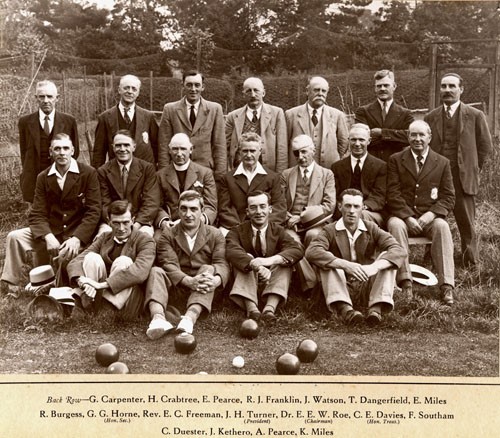
Dr Roe and the Founders of the Shipton Bowls Club
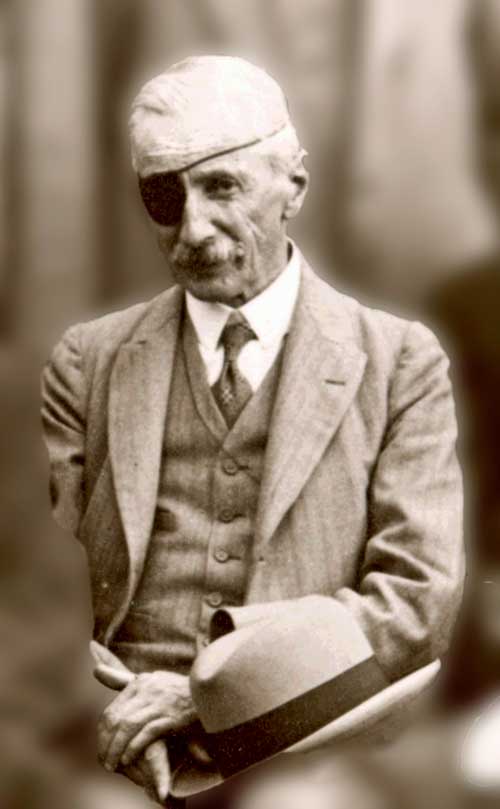
DR Roe
Transcript
But I’ll have to tell you about the little incident that I say in the winter which is Fox and Hounds and we used to make all the fun of chasing one another, you know. It was great fun. We had the packs for the hounds and the packs for horses and this sort thing, you know. All pretence, of course, but it, it was, they were happy days. You used to have just lots of laughs.
And one day I must tell you that I was playing with my brother up in the orchard and we were having, we were chasing, he was chasing me rather, and I was going down the path, a steep path from the orchard, down into the back door. And at the bottom of the path was a big grey water butt. I can see it now.
Well, of course, I chased down there, and thinking that I’m going to get there first. And I run into my grandmother with a, she’d got a big saucepan of hot boiling soda water. And I run straight into her and I got very badly scalded off. And it was the time that we had, it was Dr Roe then, and he was absolutely marvellous. He used to come in three times a day and dress my scold because I had blisters right, hanging right down.
(TY “On your neck and chest”)
Right from my, under my chin here, right down from my neck to the bottom of my chest Anyway he was so wonderful and then he wanted to send me to hospital I think you know because.
(TY “You probably would have been petrified to go away from your mother.”)
My mother said “No if she’s going to die, she’ll die here”. But he attended me so well. But he always said that I was his pet patient because he used to come in three times a day and put all this, it was like laurel leaves. It was a sort of a very thin green paper tissue, like.
(TY “Huh, I wonder what it was.”)
I don’t know what it was. But I remember him putting it on, dressing it with this and then ripping it off. Every time he come in and putting another lot on.
(TY “No ointment or salve under it?”)
No, nothing like that. It was all this green. I couldn’t tell you what it was. Never knew.
(TY “I wonder what it was. Still, it did the job. How long did this take?”)
Oh, twelve month. Twelve month.
(TY “For a four year-old”)
Yes, I was twelve months in bed with this. But on my, must have been my fifth birthday, I remember him coming in the front door with two parcels. It’s so vivid, isn’t it, when you’re a child? And Dr Roe come in with these two parcels. He said “You’ve been my”, what did he call me, pet patient I think. “And here’s something for your birthday”. One was a doll’s tea set and the other was a doll’s furniture set.
(TY “Oh, bless him.”)
Yeah, yeah, marvellous, wasn’t it?
(TY ”And by that time you were up?”)
I was up, yes. Yeah. I don’t know, I was still in bed, mind you, but I mean I’d got over the worst, I think. And I remember him coming in so vividly with these parcels. I can see him now.
(TY “How kind. Imagine a doctor doing that now. They’re all too busy aren’t they?)
Yeah, yeah wonderful, wasn’t it? Anyway, I got over that.
(TY “And now that that must have been before you went to school.”)
Oh I was at school at the little Baptist, up by the Baptist Chapel then.
(TY “Oh you were in school then?”)
I was in school then, yes.
The Full Interview
The interview with Trudy Yates includes memories of Cissie’s early family life, and her time at the infants school and then the Grammar school in Burford. Then her later time as a housemaid, including at Shipton Court. It includes her marriage into the close-knit Carpenter family . Cissie’s reminiscences also feature childhood games, memories of the local shops and businesses in Milton and Shipton, an outing to the the Scottish Highlands, and particulary this dreadful accident she had aged about four and her treatment by Dr Roe.
Here is a short extract from one of our many Oral History audio files. In it, RAF veteran Albert “Bim” Champness includes a summary of his extended family and also recalls Wychwoods village characters, in a clip from a 45-minute conversation. The full 23rd March 1995 interview covers wide-ranging details of an interesting life from difficult beginnings.
Albert Champness, known as Bim 1919-2014 Served in the RAF during the Second World War servicing aircraft used by the Dam Busters.
Albert Edward Champness born 2 May 1919 – 29 October 2014 Always known as Bim. Served in the RAF during the Second World War servicing aircraft used by the Dam Busters.
Listen Here
Bim Champness Remembers. Interviewed 23rd March 1995
Transcript
After a ten-year gap, Steven arrived and then four years after that when my wife was 39, Sarah arrived. But of course, we were very thankful for her because, as I said, we were to lose our eldest daughter.
I got my leg pulled with a friend on gapping out the children, as he put it, and he very cheekily said, “Well if you will go to bed on Sunday afternoons, what do you expect!” I didn’t touch him, but I felt like whacking him one!
Anyway, so that’s a bit about the family.
Well, what have I done in the village? I’m afraid I’m guilty of not taking too much interest in village life, although I did really. I used to love to watch the cricket and the football matches. I became, I suppose, more engaged with the Chapel than any other activities, but I thoroughly enjoyed village life.
In those older days we knew everybody and there were real characters in those days — Jackie Miles the Postman, Ridley the farmer, Wally Rawlins who owned half Milton, Shipton, Bournemouth, Reading and I don’t know what else he didn’t own but was a real character, and some of the men who worked in Groves’s Yard too, I remember well.
Not to mention the sportsmen — Perce Bridge who was a superb fast bowler, Doggie Pritchard who could mix it up with speed and spin and could act the fool at most of the matches, and one or two fine footballers, such as Frank Miles who played for the County on one or two occasions, and I remember another sportsman from Shipton, Buckney Slatter, who was urged to turn professional but played for one of the famous London amateur clubs which I think was called the Corinthians in those days.
Summary of the Full Interview
The interview is by Janet Wallace and covers Bim Champness’ life story. It includes his early life after being adopted in London, his adoptive family’s move to Milton in the early 1930s when he was 12, following many family visits to grandparents in Fifield, his apprenticeship and early working life in Milton, his marriage, wartime service in the RAF, subsequent career and retirement, family life, and involvement in village activities especially the Baptist chapel.
We use cookies on our website to give you the most relevant experience by remembering your preferences and repeat visits. By clicking “Accept”, you consent to the use of ALL the cookies.
This website uses cookies to improve your experience while you navigate through the website. Out of these cookies, the cookies that are categorized as necessary are stored on your browser as they are essential for the working of basic functionalities of the website. We also use third-party cookies that help us analyze and understand how you use this website. These cookies will be stored in your browser only with your consent. You also have the option to opt-out of these cookies. But opting out of some of these cookies may have an effect on your browsing experience.
Necessary cookies are absolutely essential for the website to function properly. This category only includes cookies that ensures basic functionalities and security features of the website. These cookies do not store any personal information.
Functional cookies help to perform certain functionalities like sharing the content of the website on social media platforms, collect feedbacks, and other third-party features.
Performance cookies are used to understand and analyze the key performance indexes of the website which helps in delivering a better user experience for the visitors.
Analytical cookies are used to understand how visitors interact with the website. These cookies help provide information on metrics the number of visitors, bounce rate, traffic source, etc.
Advertisement cookies are used to provide visitors with relevant ads and marketing campaigns. These cookies track visitors across websites and collect information to provide customized ads.