
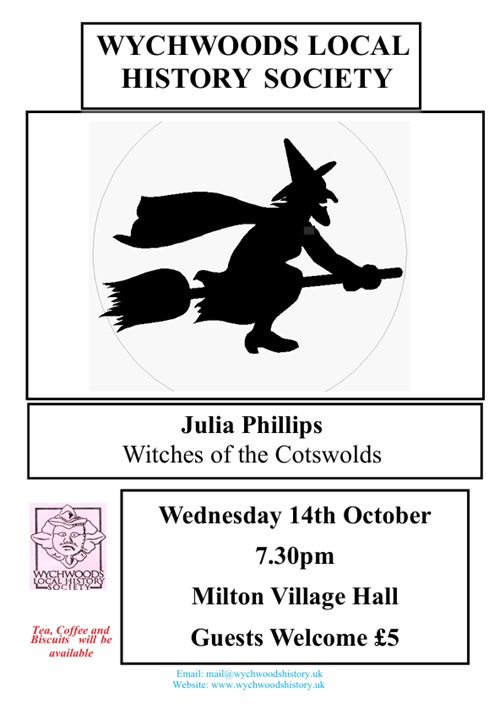
On Wednesday 14 Oct at 7.30pm we welcomed Senior Research Associate and lecturer at the University of Bristol, Julia Phillips.
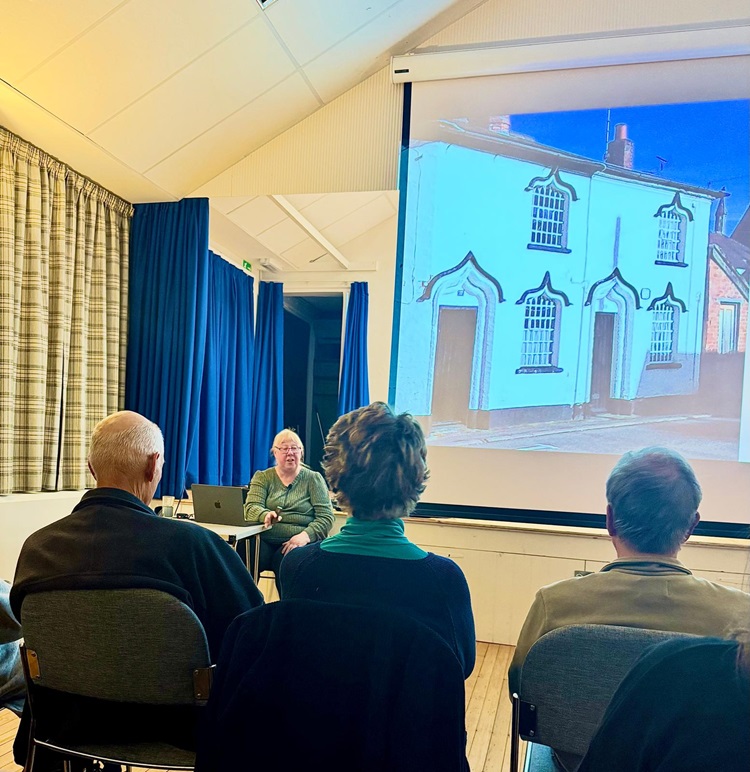
Julia presented an illustrated talk on ‘Witches of the Cotswolds’, with many examples of individual tales of folklore and supernatural intrigue through the ages.
We were pleased to have an attendance of 100+ members and guests, marking another successful event in our calendar of talks.
Witchcraft in the Cotswolds – Read More in Cotswold Life Magazine
Julia Phillips’ article Witchcraft in the Cotswolds in the 21st November 2020 edition of Cotswold Life [ opens in new tab] gives a flavour of the material which Julia covered for us.
In it, she explores the long, uneasy coexistence of fear, folklore, and rural belief that shaped witchcraft traditions across the region from the seventeenth to early twentieth centuries.
Drawing on newspaper archives and local histories, she traces how accusations arose from everyday misfortunes — sick livestock, spoiled milk, stolen tools — and how certain individuals became both feared and sought-after for their supposed powers.
Three figures illustrate the spectrum of Cotswold witchcraft lore:
- Catherine Huxley of Evesham (c.1612–1652) — a tragic example of early modern suspicion. After a child she had scolded began passing stones, neighbours claimed she had cursed the girl. Stones found by Huxley’s bed were taken as proof, and she was executed by hanging.
- Bevil Blizard of Winchcombe (1742–1836) — known locally as ‘Blizard the Wizard,’ he enjoyed respect rather than persecution. Stories tell of his scythe continuing to cut hay after he left the field, his ability to locate stolen goods, and his knack for identifying thieves.
- Ellen Hayward of Cinderford (early 20th century) — a ‘wise woman’ consulted for charms and cures. In 1906 she was charged with pretending to use witchcraft after a Worcester farmer repeatedly sought her help for his failing livestock. The magistrates dismissed the case, though such charges often led to fines or imprisonment.
Julia also recounts the 1875 murder of Ann Tennant in Long Compton, whose neighbour, terrified of witchcraft, stabbed her with a hayfork believing it would break a curse. He was found not guilty by reason of insanity and committed to Broadmoor.
The article closes with tales of shapeshifting witches, a common rural belief: hares leaping through windows and reappearing as injured old women, cats wounded by pitchforks whose owners later bore identical marks, and white animals said to be witches in disguise.
So, Julia’s article reveals how deeply witchcraft once permeated Cotswold life — a blend of fear, superstition, and folk tradition that lingered long after the Witchcraft Act abolished the death penalty. She shows that behind every tale lies a community negotiating misfortune, mystery, and the need to explain the inexplicable. The full article is here >>>> [ opens in new tab]
About Julia Phillips
Julia received her PhD for her research examining how witches and witchcraft were featured in newspapers in Victorian Britain. Her work has been published in books, academic journals, and popular magazines, and she is a regular presenter at conferences and events. Her primary research interests are the study of witchcraft in the 19th century and the development of modern Pagan Witchcraft in the 20th/21st centuries.
