This article was written by Carol Anderson to accompany an exhibition of wedding photographs from the Society’s collection spanning the later 19th to mid 20th century.
Topics
Wychwood Weddings Photographs | Wedding Fashions Early 1900s | Wedding Fashions 1920s and 1930s | Wartime Weddings | Other Clues to Dating Photographs | Where Did Local Marriages Take Place? | At What Age Could a Couple Marry? | Where Can I find a Record for a Wychwood Marriage? | Share Your Wedding Photos
Some of the photographs in the exhibition are accompanied by names and dates, allowing us to trace the lives of the people who appear in them. Others have lost their identities over time , but can still offer valuable clues to changing traditions.
The article looks at changing marriage customs and fashions, gives some guidance on dating photographs and explains where to find records of past Wychwood weddings.
The article can be seen online here, and can also be downloaded as a PDF.
Read on, or go to topics:
Wychwood Weddings Photographs
Marriages are the most celebrated of all family occasions and many families have photographs in their albums recording such events. A number of photographs of Wychwood weddings dating from the late 19th century to 1960, have found their way into the collections of the Wychwoods Local History Society. Sadly, some of these remain anonymous, a salutary reminder to us all to add names and other information to our photographs for the benefit of future family and historians! Others have been identified with the help of clues within the images themselves and the odd name or date.
Frozen in a single frame, a wedding photograph may reveal far more than the identities of the bride and groom; it can offer a glimpse into the social history of an entire community.
But until well into the 20th century, only better-off families could afford to employ a photographer to attend the wedding itself. Couples who wanted a record of their marriage often visited a local studio after the event, which makes the resulting images harder to distinguish from standard portraits. In some cases, wedding photographs took the form of individual studio portraits which would be displayed side by side in the family home, but on their own they can look much like any other portrait. One clue that these are wedding portraits is that the bride’s ring is often prominently displayed.
Wedding Fashions Early 1900s
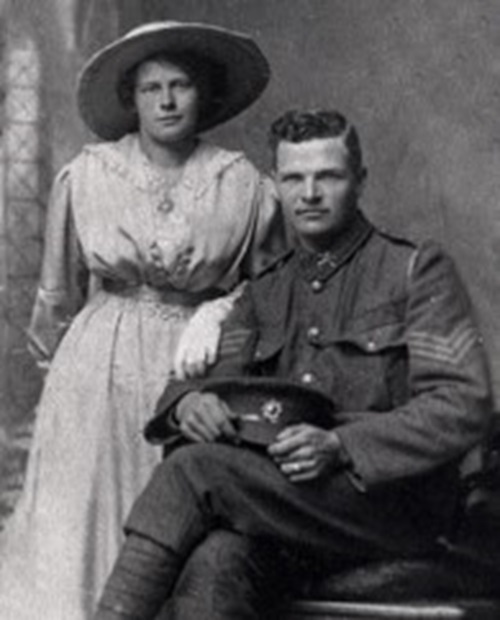
The style of the bride’s dress, the hats and outfits worn by guests, and the bouquets carried, all follow an identifiable chronology informed by the fashions of the day, which often helps to date anonymous wedding photographs. The 1890s saw the development of large group wedding photographs, often taken outdoors in the churchyard after the ceremony or in the garden of the venue for the reception, and featuring the growing middle class. The custom for brides and bridesmaids to wear floral corsages and sometimes to carry a bouquet was also growing at this time. Edwardian (1901-14) wedding photographs often look very grand owing to the extravagance of the accessories worn by the women, especially the enormous hats and the growing trend for extravagant bouquets with trailing greenery.
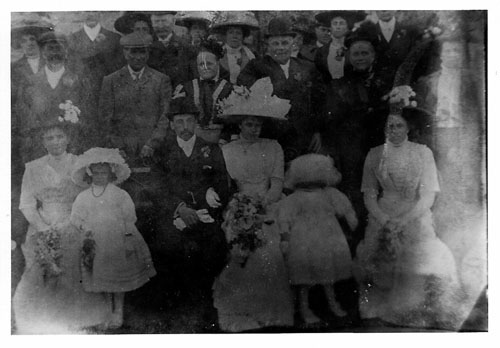
Queen Victoria had introduced the fashion for white wedding dresses but, as ordinary girls could not afford the luxury of a dress that could be worn only once, the fashion was slow to become established throughout society. By the early 20th century, although more brides were adopting white wedding attire, many women such as Margaret Hopkins, might simply choose a white blouse with a coloured skirt worn with a white hat.
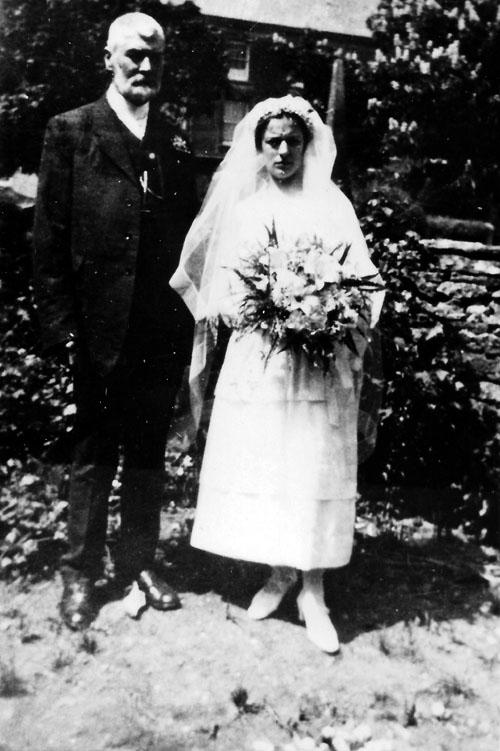
Following fashion trends wedding dresses and skirts were worn shorter from around 1915 onwards, displaying the lower leg and inspiring a fashion for white stockings and dainty shoes. Other clues as to date are also provided by trends such as the wearing of military uniform in time of war.
Wedding Fashions 1920s and 1930s
The early 1920s saw several important royal weddings at which the brides wore lavish gowns that inspired a new generation of brides, and revived the desire for a more romantic look which had been largely absent from wartime weddings. Most 1920s bridal and bridesmaid dresses were worn in a fashionable ‘afternoon’ length, but hemlines did move around between mid and lower calf, although in 1926 they rose dramatically to just below the knee. Head dresses (often low on the forehead), net veils and hats continued to be worn.
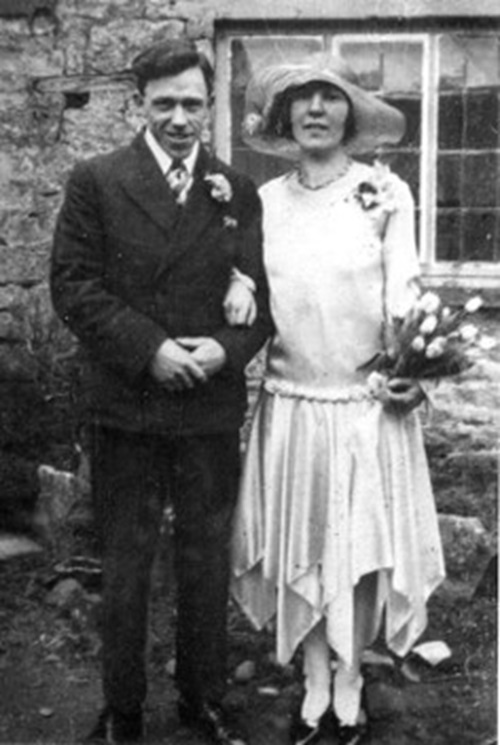
There was also a fashion in the later 1920s for young flower girls to wear distinctive wired headdresses like Dutch caps. Upper and middle-class bridegrooms continued to wear a dark morning coat and grey trousers, whilst other classes favoured a lounge suit with short, narrow legs and turn-ups. A knotted tie or bow tie was worn and stylish felt homburg and trilby hats replaced the traditional bowler.
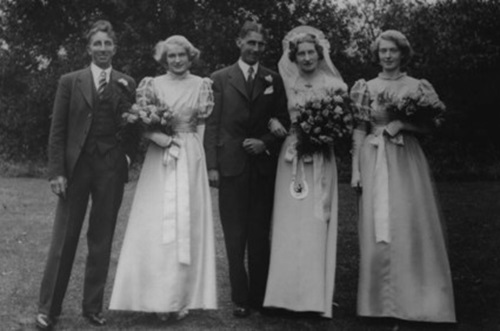
By the 1930s bridal styles had become very diverse. Influenced by Hollywood, soft, clinging, elaborate wedding gowns of varying lengths, including an evening length that swept the floor with a long train, became popular. Carnations and roses continued to be favoured for wedding bouquets, a trend that continued into the 1940s, but white lilies also came into fashion. By the late 1930s long, trained gowns in pure white satin held sway. Male attire followed the already established pattern but adopted 1930s fashion for double-breasted lounge suits.
Wartime Weddings and Later
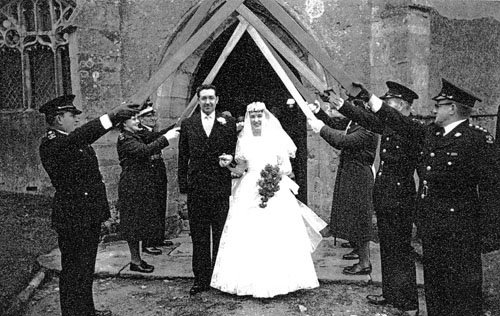
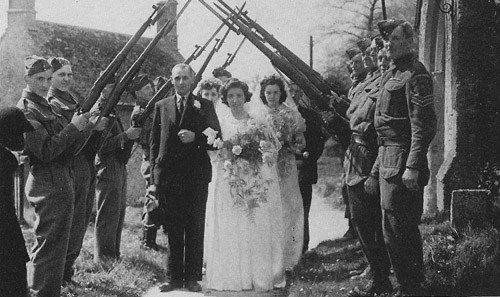
Church weddings continued to take place throughout the Second World War. In response to circumstances many brides chose to wear smart knee-length dresses or suits with a floral spray or neat posy and a stylish hat. Cloth shortages dictated that the wedding gowns (although some brides adapted dresses from the 1930s) of wartime and post-war brides were generally made with narrow or only slightly flared skirts without trains, but veils were often long and worn well back on the head with a tiara. Bridesmaids often wore short veils, a useful clue to dating. As so many men were in the services it became common for men of all classes to wear their uniform. For those not in uniform a three-piece, double-breasted lounge suit was the norm.
Other Clues to Dating Photographs
Photography itself can also provide clues to the date of a wedding. As cameras gradually became more widely available, and more people could afford to employ a photographer to attend the event and even take photographs themselves, so often more photographs of the wedding and its participants have survived. The outdoor group photographs which began to appear in the late 19th century gradually became more common in the early 20th century and increasingly several different photographs were taken of the event. During and immediately after the First World War studio portraits became common again.
Fashions also developed within wedding photography alongside the technology, as the photographer looked to capture the informal as well as the formal aspects of the wedding. A greater range of standard images began to appear including the bride getting out of her car or standing at the church gate with her father, or the happy couple leaving church between the ranks of their guard of honour.
Where Did Local Marriages Take Place?
Until the mid-18th century marriages could take place anywhere, provided they were conducted before an ordained clergyman of the Church of England. This encouraged secret and bigamous marriages which did not have parental consent. The Marriage Act of 1753 declared that all marriage ceremonies must be conducted by a minister in a parish church or chapel of the Church of England to be legally binding. No marriage of a person under 21 was valid without the consent of parents or guardians. Clergymen who disobeyed the law were liable to 14 years transportation. Jews and Quakers were exempt from this law, but religious non-conformists and Catholics had to be married in Anglican churches.
Marriages usually took place in the parish where the bride was living, but if she were not living at home or her parents were dead, the marriage could take place where she or the groom were living.
Early Wychwoods marriages took place in parish churches in Ascott, Fifield and Shipton, although it was not until 1538 that all parish priests were required to keep registers of baptisms, marriages and burials. Some Catholic parishes kept spasmodic records as early as the 13th century. The earliest surviving recorded marriage in Shipton took place in 1528 and in Ascott in 1570. Milton did not have a parish church until 1855, before that time anyone living in Milton would have married in Shipton. Likewise, as it did not have its own church until 1853, Leafield marriages often took place in Shipton or Ascott.
In 1836 new legislation enabled Non-Conformists and Catholics to be married in their own places of worship. The Milton Baptist Church features as the background to Groves family wedding photographs in the later 19th century, but the Baptist chapel in Ascott did not hold its first wedding until 1957.
From 7th July 1837, alongside religious ceremonies, all marriages had to be documented centrally via District Registration Offices. It also became possible to be married in a Registry Office without the need for a religious service.
At What Age Could a Couple Marry?
The age at which couples could marry also changed over time. In 1929 the legal age for marriage with parental consent was set at 16 (it had previously been 12 for girls and 14 for boys). In 2022 this was increased to 18.
Where Can I Find the Record for a Wychwood Marriage?
The digitised records for church marriages up to 1930 are available online from the genealogical subscription site Ancestry. These can be consulted free of charge in the Wychwood Library, as can marriage records, including Roman Catholic Parish Records, held by Findmypast.
Using the search facility of the FreeBMD online site [ here – opens in new tab ] you can find references to marriages recorded in the Chipping Norton district (which covers the Wychwood villages) from 1837 to 2000 (the records aren’t yet complete from about 1994 onwards). From these records, with a little detective work, it’s possible to establish the names of those marrying and the quarter (of the year) in which the marriage took place. To obtain more details you need to order a copy of the certificate from the General Register Office [ here – opens in new tab ] which maintains the national archive of births, marriages and deaths dating back to 1837.
Hard copy transcripts of parish registers, including both marriages and banns (for those from the parish who were being married elsewhere), from Ascott, Fifield, Leafield, Milton and Shipton with surname indexes, are held by the Wychwoods Local History Society. Please contact us to discover more.
Although the most recent Wychwood wedding photograph in the Society’s Archive dates from 1960, articles written by Wendy Pearse in the Ascott Grapevine: these bring us almost up to date with a selection of images of weddings that have taken place at Holy Trinity Church in Ascott up to 2021.
Wendy’s articles can be found here:
Grapevine Issue 123 pp 33-40 PDF here: opens in new tab
Grapevine Issue 124 pp 18-21 PDF here: opens in new tab
Do You Have Wedding Photos to Share?
If you have a Wychwood wedding photograph with a story that you would like us to copy and add to our collections, please contact us.
Wychwood Weddings Photographs | Wedding Fashions Early 1900s | Wedding Fashions 1920s and 1930s | Wartime Weddings | Other Clues to Dating Photographs | Where Did Local Marriages Take Place? | At What Age Could a Couple Marry? | Where Can I find a Record for a Wychwood Marriage? | Share Your Wedding Photos